Juicy, golden roast turkey with rich gravy – no basting, no stress.
If roasting turkey stresses you out, you are not alone. It’s the one roast we all tiptoe around – it’s pricey, it only comes out on the biggest days of the year, and there are about a thousand different opinions on how you should cook it. No wonder everyone feels intimidated! But the secret is … it doesn’t need to be a big ordeal. With a clear, simple method, turkey becomes surprisingly easy – and it is a lot more forgiving than you’d think.
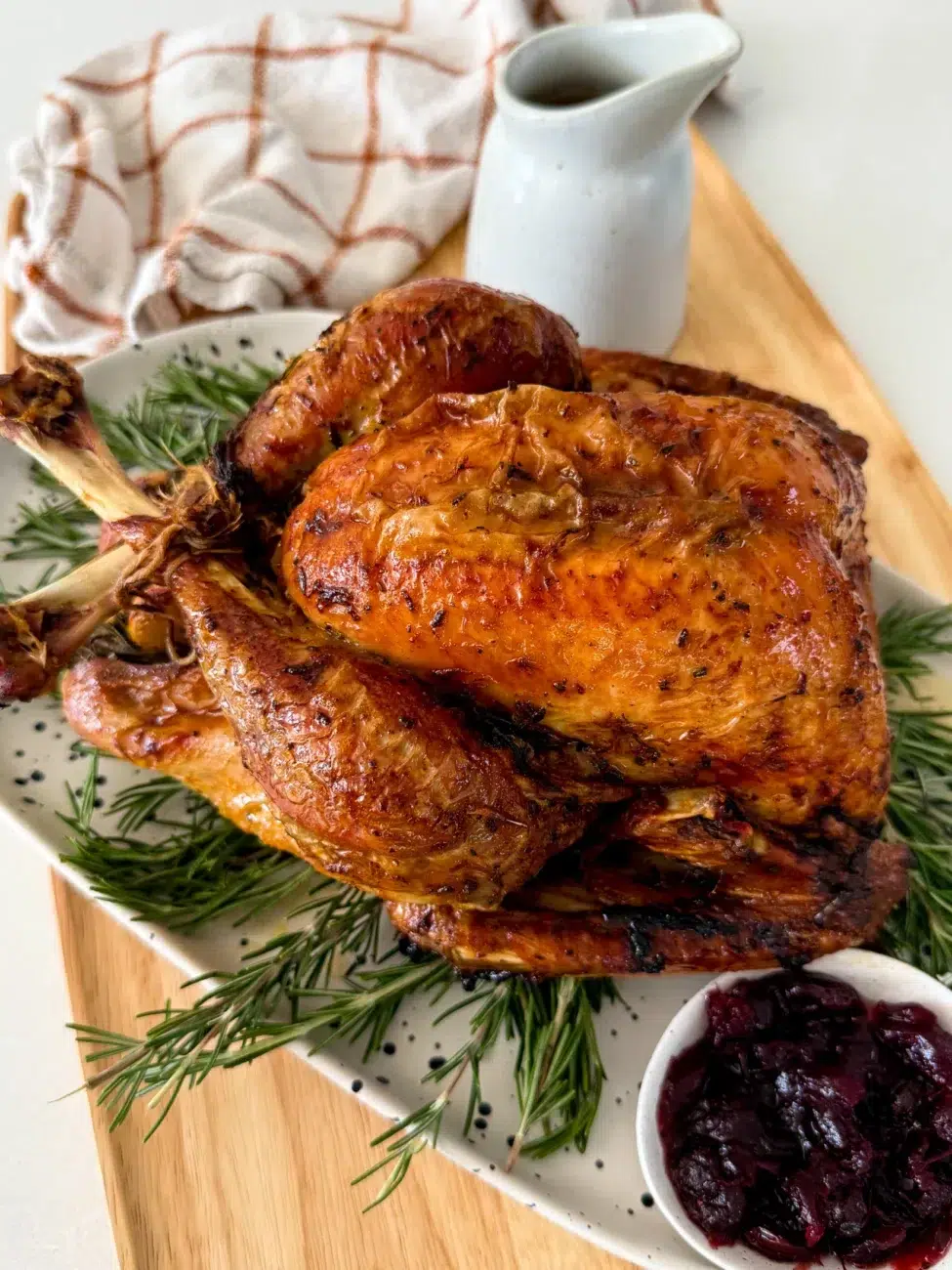
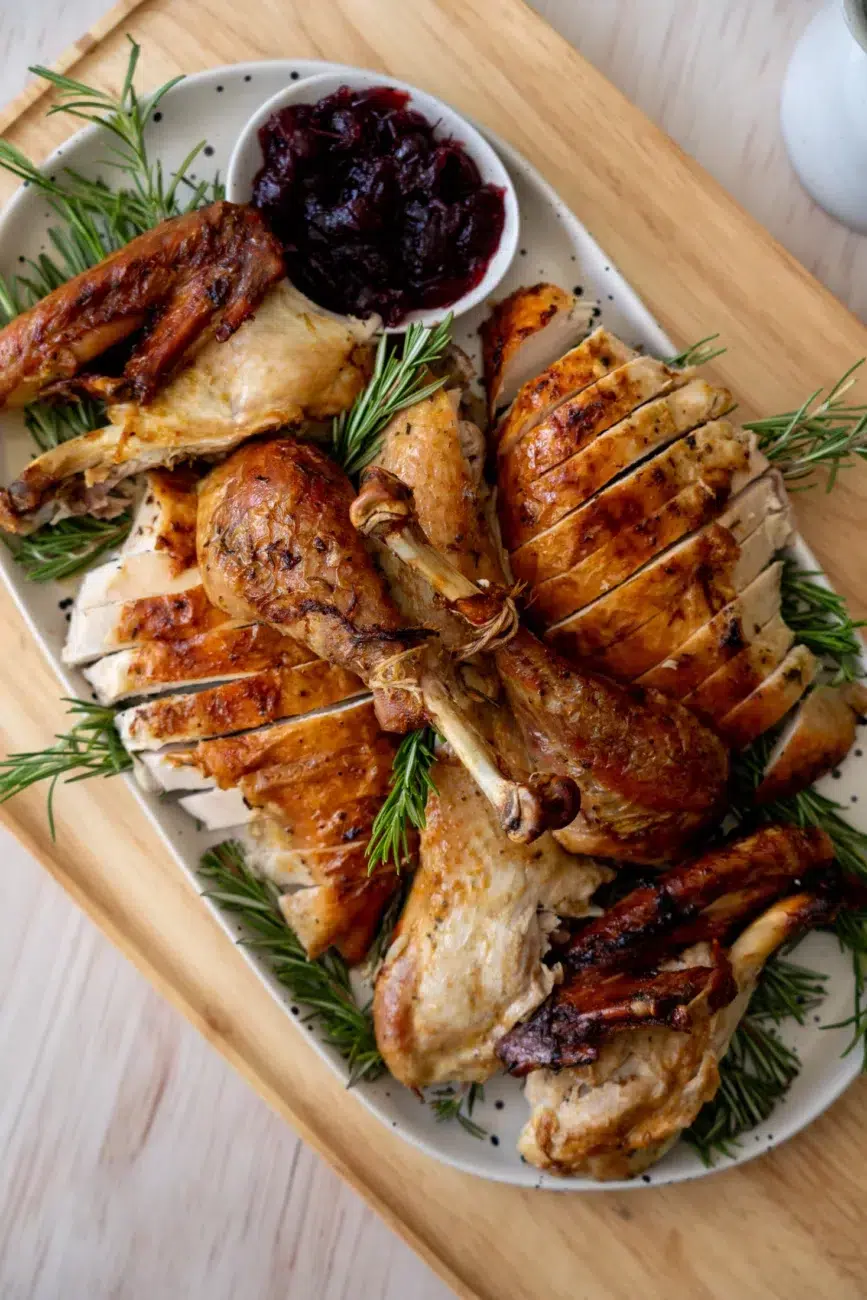
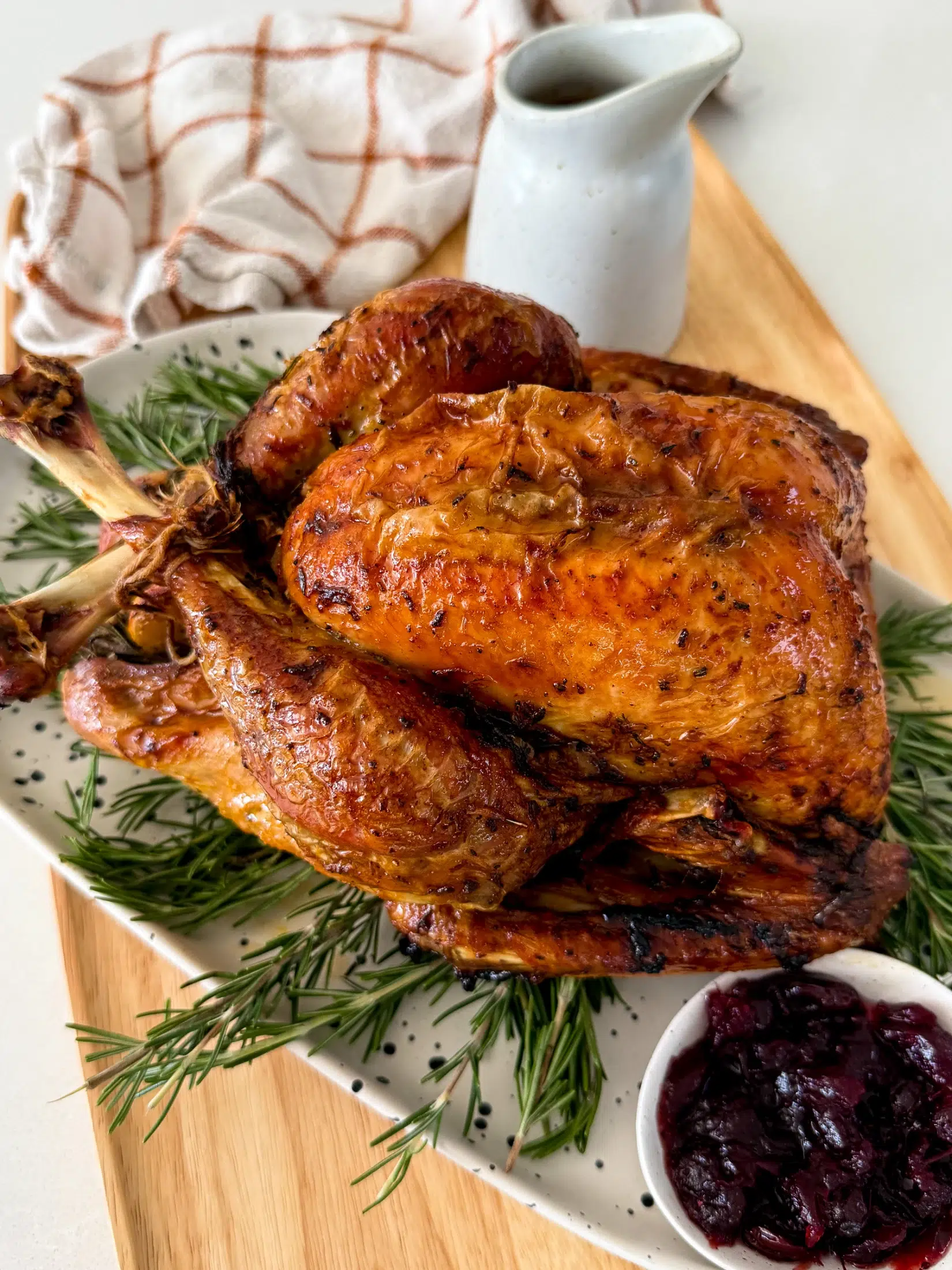
Presented whole before carving for that moment at the table. Simple rosemary for freshness, cranberry sauce on the side – a classic Christmas scene that always impresses.
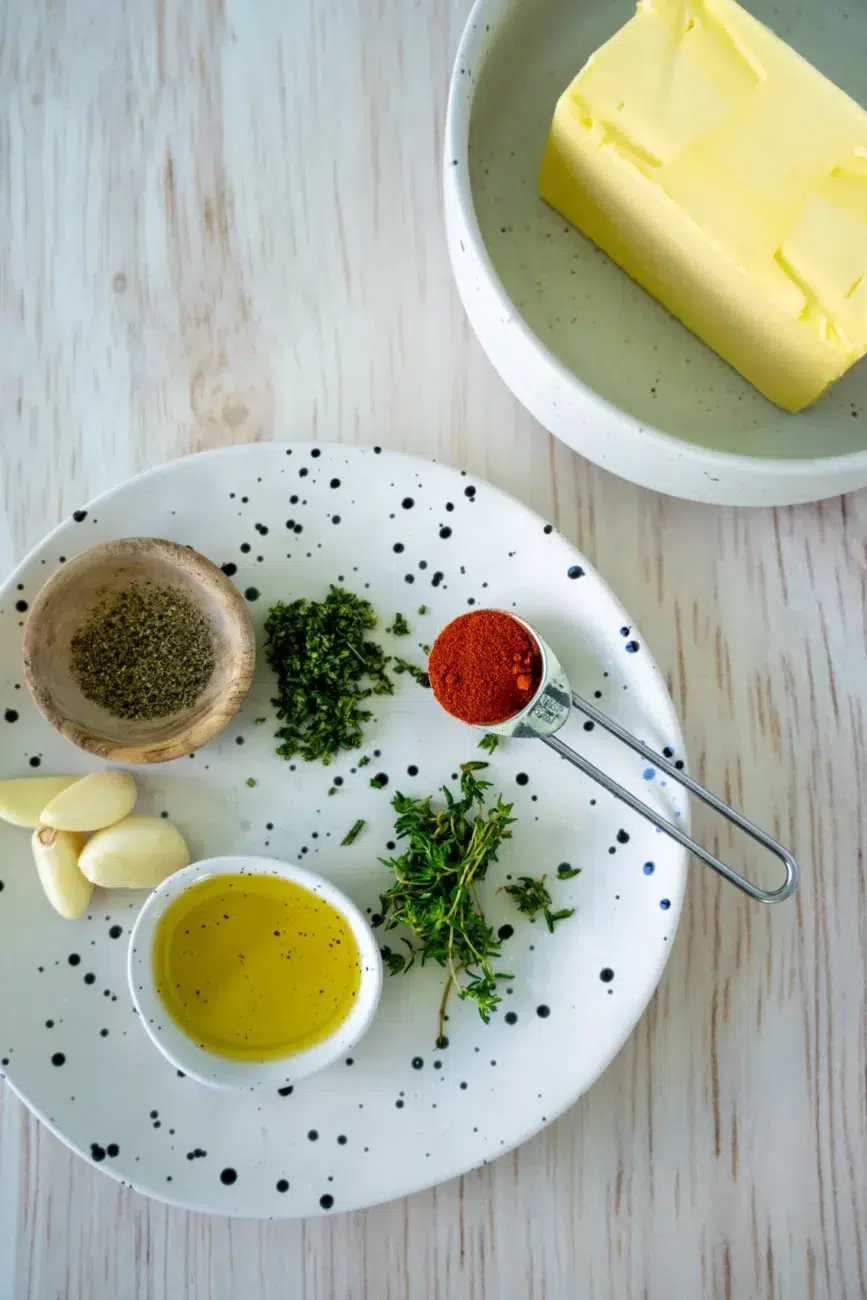
All the garlic herb butter ingredients – softened butter, garlic, rosemary, thyme, olive oil, sweet paprika and black pepper. This mix is what keeps the breast juicy, seasons the meat beautifully and helps the skin turn golden without needing to get under the skin.
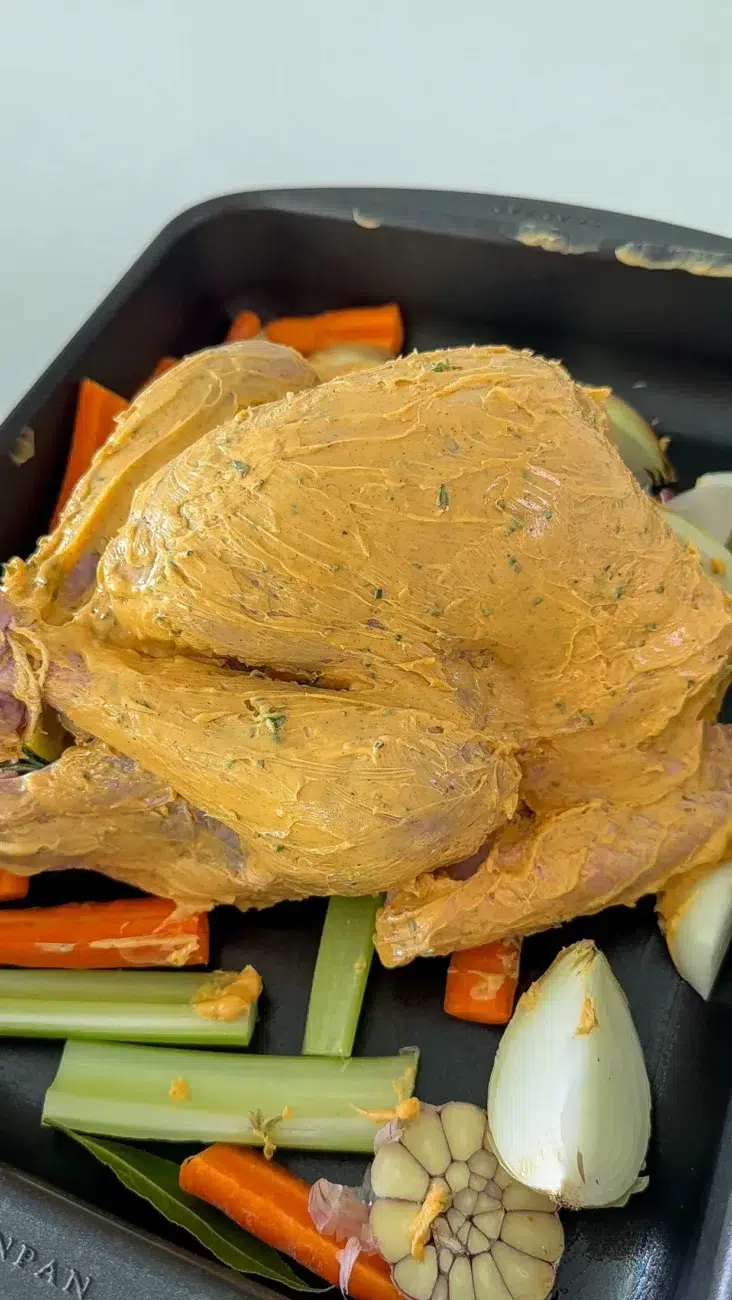
The turkey should be thickly coated in the garlic butter – really generously. A heavy layer means juicy meat and a deeply golden finish without any need for basting. Don’t hold back here as this is the key to flavour.
This Garlic Herb Butter Roast Turkey with Gravy (No Basting!) gives you juicy, beautifully golden turkey without the endless steps, the basting or the stressful lead-up. You can dry-brine the turkey the day before (and yes, it does make the meat extra tender), but if you forget or don’t have the time, the turkey will still be absolutely delicious. The real magic comes from slathering the turkey in a generous garlic herb butter (no fuss, no slipping butter under the skin needed!), which keeps the breast perfectly juicy every single time.
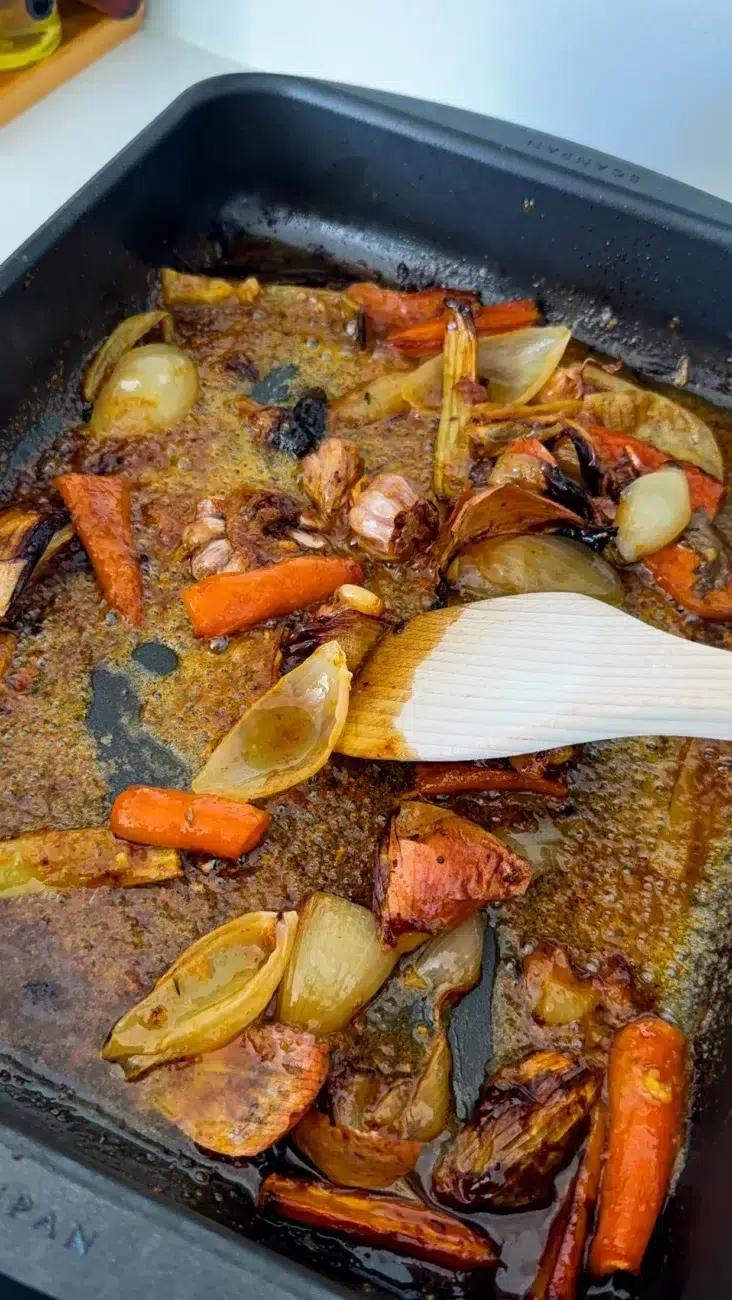
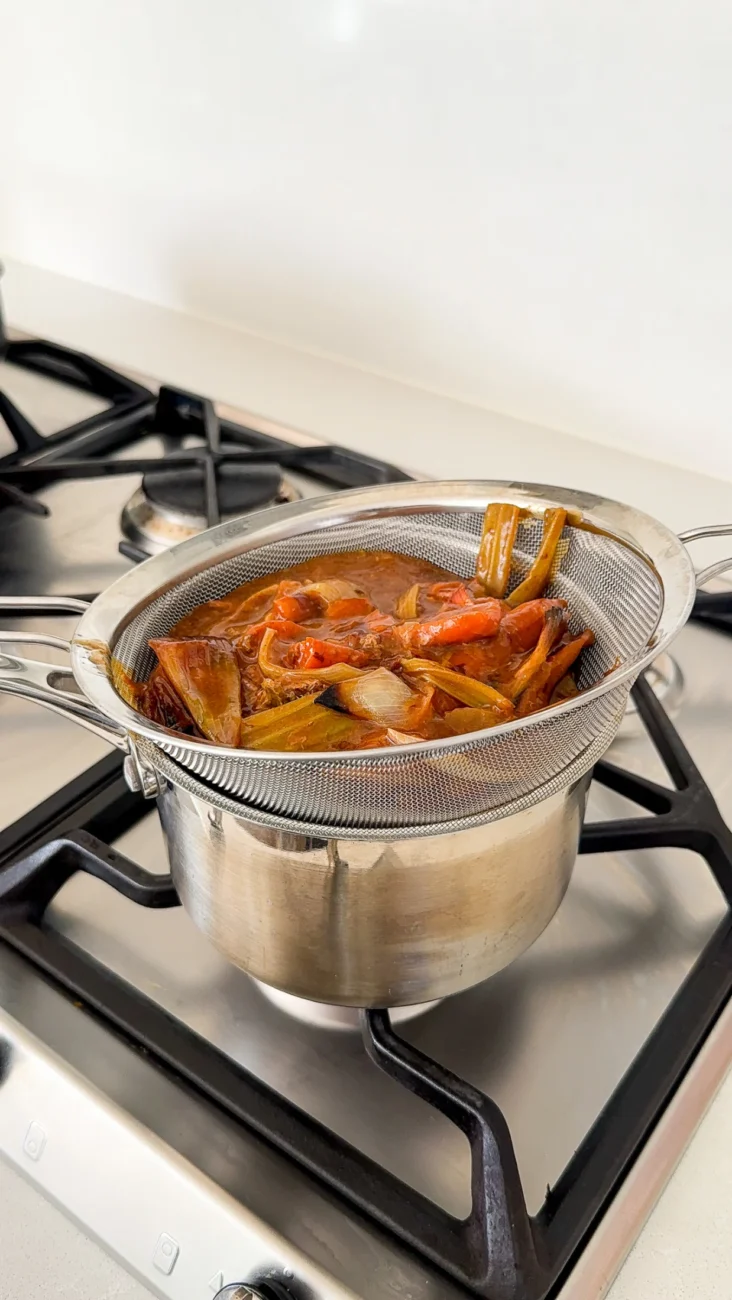
This is where the flavour concentrates. We cook the vegetables with flour to form a base for the gravy, scraping the browned bits from the tray so nothing goes to waste.
Pushing everything through a sieve extracts every bit of flavour from those caramelised vegetables. What drips through is liquid gold – smooth, rich pan gravy ready to serve.
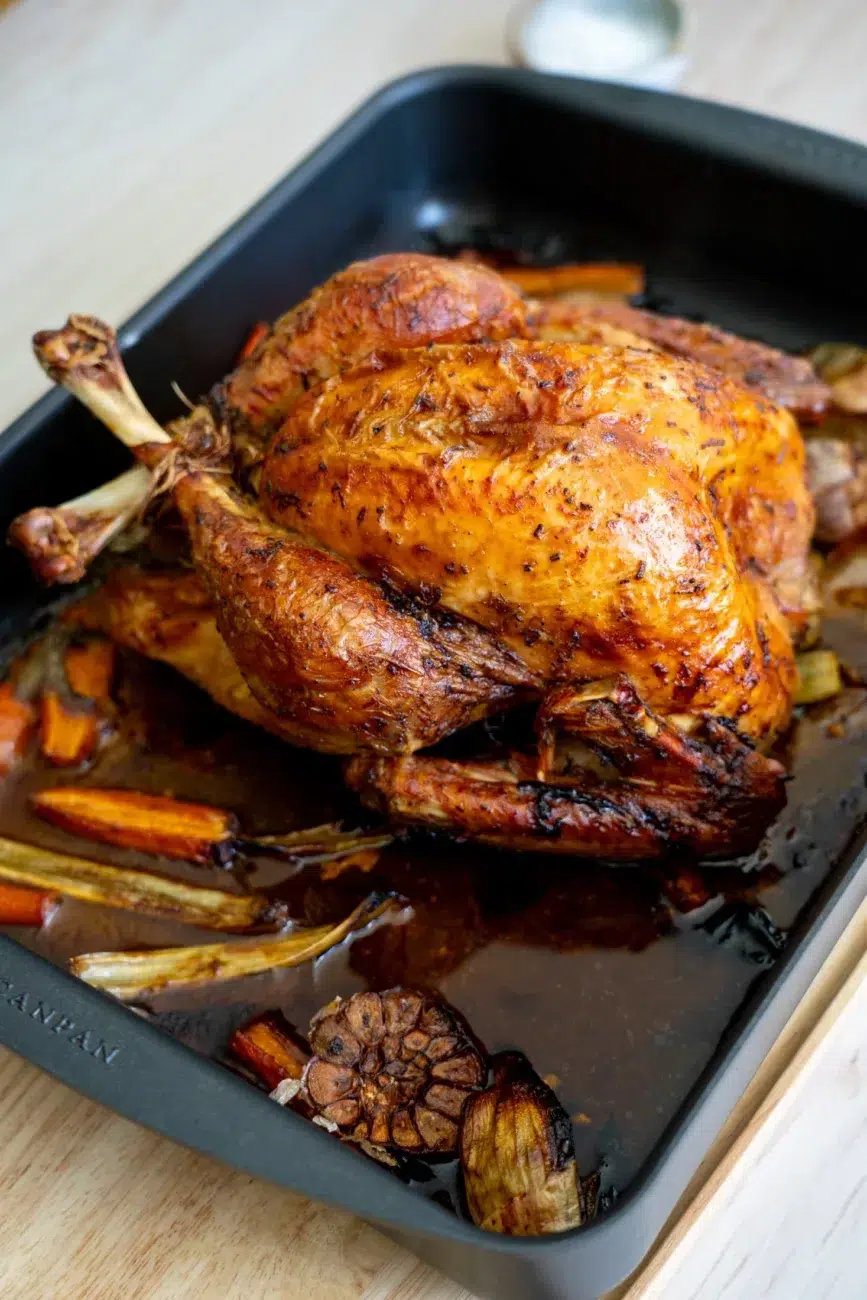
The turkey sits on a base of carrots, celery, onion and garlic with a splash of water underneath. As it cooks, the vegetables steam, the butter melts, and everything mingles into the most beautiful roasting juices, which later become the kind of gravy people scrape the bowl for. And finally, the resting time – the one step that everyone usually rushes – is what helps the turkey stay moist and tender.
I’ve tested this method over and over and really found the sweet spot. The right temperature, the right timing, and the exact steps that make the whole process feel easy, calm and doable – even if it’s your first time cooking a turkey. This is my go-to method and, once you try it, I think it’ll become yours too!
Caramelised, golden turkey resting on top of those vegetables, which have caught all the buttery pan drippings. Those vegetables are what become the gravy and add natural sweetness and depth of flavour.
Where do I buy a turkey?
Australia
Most major supermarkets sell whole turkeys in the lead-up to Christmas, including Coles, Woolworths and ALDI. You’ll usually find frozen turkeys first, with fresh turkeys appearing closer to Christmas week. For higher-quality birds or to reserve one early, check your local butcher, poultry shop or farmer’s market. Turkey sells out fast once December hits, so it’s worth planning ahead. The size I personally use (and what this recipe is written for) is 3.4–4 kg (7¼–8¾ lb), but this recipe works beautifully for turkeys up to 6 kg (13 lb).
United States
In the US, whole turkeys are widely available around both Thanksgiving and Christmas. You’ll find them at major supermarkets such as Whole Foods, Trader Joe’s, Kroger, Publix, Safeway, Costco, Target and Walmart. Fresh birds tend to appear only in the 2 weeks leading up to Thanksgiving, so if you want a specific size or brand, it’s worth pre-ordering from your local butcher or specialty poultry shop.
United Kingdom and Europe
In the UK, turkeys are most commonly sold closer to Christmas, especially at Tesco, Sainsbury’s, Waitrose, M&S, Asda, Morrisons and Aldi/Lidl. Fresh turkeys often require pre-ordering, especially if you want a specific weight. Many families also purchase from local butchers, farm shops or Christmas markets. In Europe, turkey is less central to Christmas, but you’ll find whole birds at larger supermarkets and regional butchers – though stock can be limited, so reserving a bird ahead of time is always a good idea.
Once carved, I arrange slices of breast around the edges of the platter and pile thighs and drumsticks in the centre. A few rosemary sprigs tucked in makes it look effortlessly beautiful and easy to serve.
How many people does a turkey feed?
A good rule of thumb is 500–600 g (1–1¼ lb) of whole turkey per person (this accounts for bones, wings, legs and the cavity).
So if you’re feeding:
4–6 people → 3–3.5 kg (6½–7¾ lb) turkey
6–8 people → 3.5–4.5 kg (7¾–9¾ lb) turkey
8–10 people → 4.5–5.5 kg (9¾–12 lb) turkey
10–12 people → 5.5–6 kg (12–13 lb) turkey
This recipe is written for a 3.4–4 kg (7¼–8¾ lb) bird, but works for turkeys up to 6 kg (13 lb) – just adjust the salt for dry-brining (see the recipe for details).
Should I buy a huge turkey?
No. For the best results and to keep this foolproof, I prefer to avoid turkeys larger than 6 kg (13 lb). Bigger birds can cook unevenly, take hours longer, and the breast can dry out before the legs are fully cooked. (And make sure your oven is big enough to hold the turkey and a tray that’s large enough. You might prefer to cook two smaller birds.)
What if I’m feeding a big crowd?
Cook two medium turkeys (3.5–5 kg/7¾–11 lb each) instead of one large one. Faster, juicier, and double the crispy skin.
Do I need to dry-brine or wet-brine my turkey? What even is a brine!? And how much extra time should I allow?
A brine is simply salt used to season the turkey ahead of time. Wet-brining means soaking the turkey in a salty water bath (messy, takes over your whole fridge, and can leave the skin soggy). Dry-brining is the easier, cleaner and more effective option – you just sprinkle salt over the turkey and let it work its magic in the fridge. It deeply seasons the meat, keeps it juicy and helps the skin turn beautifully golden. This recipe uses a simple dry brine because it gives the best flavour with the least effort. You will need to start 12 to 24 hours before. If you forget or don’t have time, skip it. The turkey will still be delicious. The dry brine is strongly recommended but not mandatory!
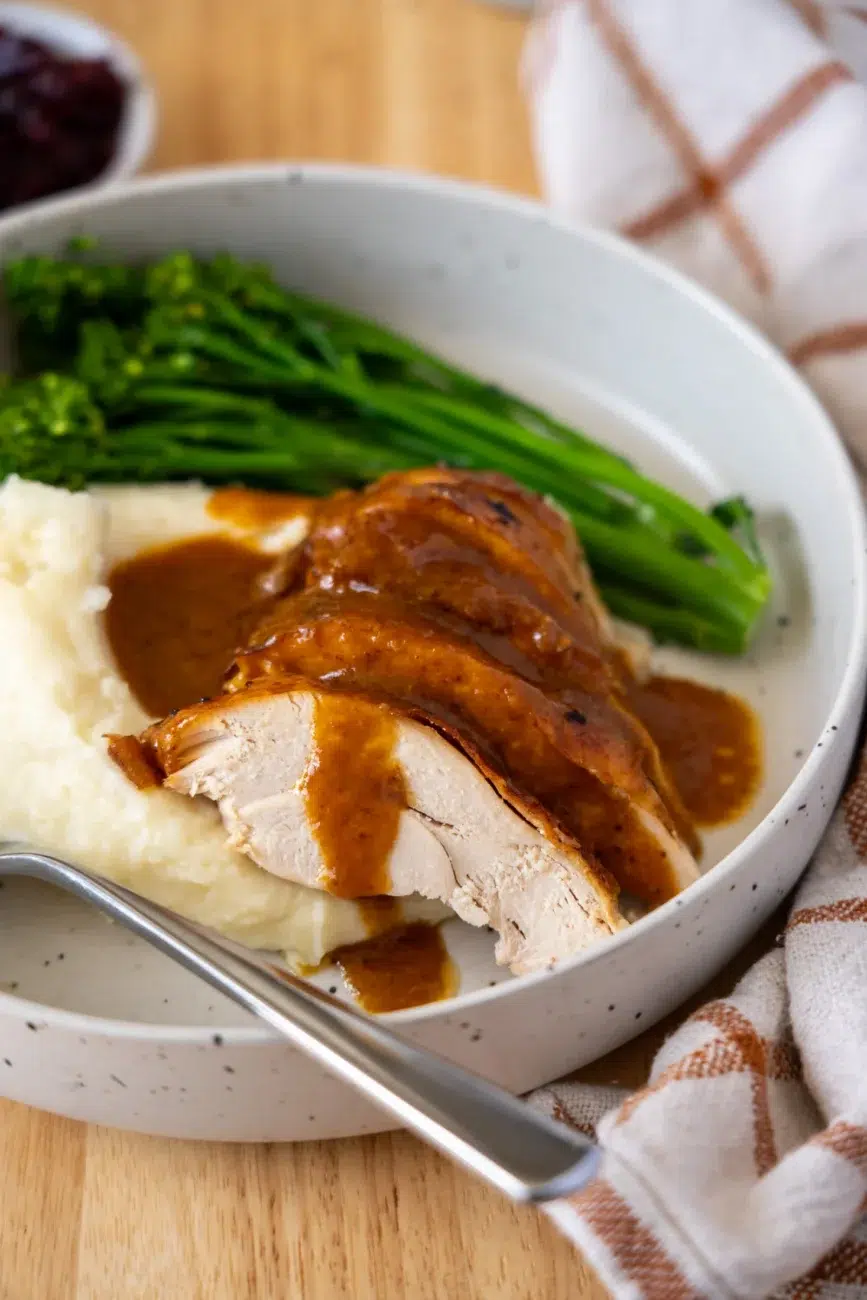
A full plate moment – tender turkey with creamy mash, broccolini (tenderstem broccoli) and gravy poured over the top. This is how I love to serve it at the table, with simple sides that let the turkey shine!
Is it okay to not cover my turkey as it cooks?
Yes – completely fine. This method is designed for roasting uncovered at a steady 180°C (350°F) (160°C/325°F fan-forced) oven temperature. The garlic herb butter and low temperature keep the meat juicy without the need for basting or foil. The only time you’ll use foil is if a small area is browning faster than you’d like – in which case, just cover that spot loosely. Otherwise, leave the turkey uncovered the whole way for golden, even browning.
Can I stuff my turkey?
This recipe uses aromatics only (lemon, herbs, garlic, onion) in the cavity, which:
Helps heat circulate
Allows quicker, more even cooking
Keeps the meat juicy
How do I thaw a turkey?
Thaw in the fridge – this is the safest method. Allow roughly 12 hours per 1 kg (2 lb).
Weight
Thaw time
3 kg (6½ lb)
36 hours
4 kg (8¾ lb)
48 hours
5 kg (11 lb)
60 hours
6 kg (13 lb)
72 hours
Place the turkey on a tray to catch any liquid.
Emergency thawing method – only if you’re short on time! Keep wrapped and thaw in cold water, changing the water every 30 minutes. Allow 1 hour per 500 g (1 lb).
If you enjoyed Garlic Herb Butter Roast Turkey with Gravy (No Basting!), I think you’ll love:
This Garlic Herb Butter Roast Turkey with Gravy (No Basting!) recipe gives you the ultimate juicy roast turkey that’s truly foolproof – no brining buckets, no basting, no complicated steps. You can dry-brine for extra tenderness and browning (recommended, but optional), then roast low and slow over vegetables to create built-in pan drippings for a rich homemade gravy. Perfect for Thanksgiving, Christmas, entertaining and first-time turkey cooks.
Prep 20 minutesmins
Cook 3 hourshrs
Total 3 hourshrs20 minutesmins
Servings: 6
Ingredients
TURKEY
1 x 3.4–4 kg (7¼–8¾ lb) whole turkey, completely thawed (see note 1 for larger turkey sizes and cooking times, see note 2 for thawing, see note 4 for cooking turkey breast)
1whole lemon, halved
1whole garlic bulb, unpeeled, halved
1brown onion, quartered
4thyme sprigs, or more if desired
4rosemary sprigs
DRY-BRINE (OPTIONAL – apply the day before cooking)
2tbspsea salt flakes (for a 3.4–4 kg/7¼–8¾ lb turkey – see note 3 for salt amounts for larger turkeys)
VEGETABLE BASE
2carrots, chopped into batons
2celery stalks, chopped into batons
2brown onions, quartered
1whole garlic bulb, unpeeled, halved
2bay leaves
375ml(1½cups)water
GARLIC HERB BUTTER
250g(9oz)unsalted butter, softened (for larger turkey sizes, see note 1)
Prepare the turkey – Trim off the tail (the “parson’s nose”), any excess fat or loose skin, and, if necessary, remove any stray feathers (I use my fingers or scissors to snip them off). If necessary, take out the neck and giblets from the cavity (discard or place in the base of the cooking tray for the gravy, if desired – note not all turkeys will have these). Pat the turkey dry with a paper towel.
Dry-brine the turkey 12–24 hours prior (optional, but recommended) – Sprinkle 1½ tablespoons of the salt evenly all over the skin. Sprinkle the remaining ½ tablespoon inside the cavity. See note 3 for salt amounts for larger turkey sizes. Place the turkey, uncovered, in the fridge for 12–24 hours. Do not rinse the turkey before cooking. If you don’t have time to leave the turkey in the fridge for 12–24 hours, don’t panic! Salt the turkey as per this step and leave it for as long as you can, or simply continue the recipe and cook it immediately. Brining gives a noticeably juicier result, but the turkey is still delicious without it.
Fill the cavity – Remove the turkey from the fridge 1 hour before cooking. Do not wipe away the salt. Place the lemon halves, garlic halves, onion quarters, thyme and rosemary inside the cavity. Tie the legs loosely with kitchen string and tuck the wings underneath.
Make the garlic herb butter – In a bowl, combine the softened butter, olive oil, garlic, rosemary, thyme, paprika and pepper. Turn the turkey breast-side down and rub 2–3 tablespoons of the butter over the back and under the wings. Turn the turkey breast-side up.
Set up the roasting tray – Place the carrots, celery, onions, halved garlic bulb and bay leaves in a large roasting tray. Pour in the water. Place the turkey breast-side up directly on top of the vegetables. Pour the remaining butter mixture on top of the turkey and use your hands to ensure the turkey is coated as evenly as possible.
Roast – Preheat the oven to 180°C (350°F) (160°C/325°F fan-forced). Place the turkey on the lowest rack in the oven. Roast the turkey, uncovered, for 3 hours, or until the breast reaches 70–75°C (158–167°F) on a meat thermometer, and the thigh reaches 75–80°C (167–176°F) – see note 1 for cooking times for various sizes. If there are any areas browning too quickly, cover them loosely with foil. If the turkey is paler than you'd like near the end, increase the oven to 200°C (400°F) (180°C/350°F fan-forced) for the last 15 minutes of cooking to deepen the colour. There is no need to baste the turkey during roasting!
Rest – Transfer the turkey to a tray and rest for 30 minutes before carving.
Make the gravy – Place the roasting tray (including all the juices and fat) on the stovetop over medium heat. Stir the flour into the vegetables and fat and cook for 2 minutes, scraping up the browned bits. Pour in the chicken stock. Simmer for 6–8 minutes, breaking up the vegetables with a wooden spoon as they soften. Push everything through a fine sieve into a saucepan or jug. Discard the solids.
Serve – Place the turkey on a platter. Arrange the rosemary sprigs around the platter and serve with the gravy and cranberry sauce on the side. I like to present it this way at the table before carving.
Carve the turkey – Place the rested turkey on a large board. Start by removing the thighs: gently pull each leg outward and cut through the natural joint where the thigh meets the body. Separate the drumstick from the thigh if you like. Next, remove the wings by cutting through the joint where each wing attaches to the breast; you can cut each wing into two pieces (the “flat” and the “drumette”) if desired. To remove the breast meat, run the knife down one side of the breastbone and follow the ribcage all the way down until the whole breast comes off in one piece. Place the breast on the board and slice it crossways into even pieces. Save the frame for stock (you can freeze it).
Plate the turkey – Arrange the sliced breast, thighs, drumsticks and wings on a large serving platter. Add rosemary sprigs for presentation if you like. Serve with the warm gravy and cranberry sauce on the side and with mashed potato and steamed broccolini, or the sides of your choice.
Nutrition information
Nutrition Facts
Garlic Herb Butter Roast Turkey with Gravy (No Basting!)
Amount per Serving
Calories
422
% Daily Value*
Fat
38
g
58
%
Saturated Fat
22
g
138
%
Trans Fat
1
g
Polyunsaturated Fat
2
g
Monounsaturated Fat
12
g
Cholesterol
92
mg
31
%
Sodium
3293
mg
143
%
Potassium
321
mg
9
%
Carbohydrates
18
g
6
%
Fiber
3
g
13
%
Sugar
5
g
6
%
Protein
4
g
8
%
Vitamin A
4749
IU
95
%
Vitamin C
19
mg
23
%
Calcium
62
mg
6
%
Iron
1
mg
6
%
* Percent Daily Values are based on a 2000 calorie diet.
Note 1 – Cooking times A 3.4–4 kg (7¼–8¾ lb) turkey typically takes 3 hours – 3 hours 10 minutes at 180°C (350°F) (160°C/325°F fan-forced). As a guide, cook your turkey for 15 minutes per 500 g (1 lb), but always rely on internal temperature:
70–75°C (158–167°F) in the thickest part of the breast
75–80°C (167–176°F) in the thigh
While I rarely use meat thermometers in my cooking, I do recommend one for cooking turkey (especially if it’s your first time). Cooking time guide (up to 6 kg/13 lb)
Start checking the internal temperature with a meat thermometer 20–30 minutes before the earliest time on the range. This recipe works for a turkey up to 6 kg (13 lb). There is no need to modify the ingredients. The only thing you may want to increase is the butter ratio – 250 g (9 oz) is plenty, but for ease of coverage, you can increase the butter up to 350 g (12½ oz). Cooking two turkeys?Roasting two medium turkeys (3.5–5 kg/7¾–11 lb each) is often easier and juicier than cooking one very large bird. Place them in separate roasting pans, ensuring air can circulate around both. Cooking time will be similar to a single turkey of the same size, however allow an additional 15–30 minutes total to account for heat recovery and oven load. Begin checking the temperature at the regular timeframe, but understand they may need longer. Use internal temperature and a meat thermometer (not time) as the final measure – check each turkey individually as one may cook faster than the other.Butter scaling (optional)250 g (9 oz) butter is plenty for a 3–4 kg (6½–8¾ lb) turkey, but if your turkey is 5–6 kg (11–13 lb), you may increase to 300–350 g (10½–12½ oz) for easier coverage and extra richness.Note 2 – How to thaw a turkeyThawing in the fridge is the safest method. Allow 12 hours per 1 kg (2 lb) of turkey.
3 kg (6½ lb) → approx. 36 hours
3.4 kg (7¼ lb) → approx. 40 hours
4 kg (8¾ lb) → approx. 48 hours
4.5 kg (9¾ lb) → approx. 54 hours
5 kg (11 lb) → approx. 60 hours
6 kg (13 lb) → approx. 72 hours
For best results, avoid turkeys larger than 6 kg (13 lb). Bigger birds can cook unevenly, take significantly longer to roast, and are more prone to dry breast meat. If you’re feeding a large group, it’s better to cook two medium turkeys (3.5–5 kg/7¾–11 lb each) rather than one oversized bird.How do I urgently thaw a frozen turkey?For a faster thaw, place the wrapped turkey in a sink of cold water, changing the water every 30 minutes. Allow 1 hour per 500 g (1 lb). This is for emergencies only! Use the fridge method above for best results. Note 3 – Dry-brine and salt amountsDry-brining is recommended for the juiciest, most evenly seasoned turkey, but it is not mandatory. If skipped, the recipe will still work beautifully – brining just gives you a more tender, better-browned result.Salt guide using sea salt flakes:
3–4 kg (6½–8¾ lb) turkey → 2 tbsp (as listed in ingredients)
4.5–5 kg (9¾–11 lb) turkey → 2½ tbsp (½ tbsp inside cavity, remaining all over outside)
5.5–6 kg (12–13 lb) turkey → 3 tbsp (½ tbsp inside cavity, remaining all over outside)
Note 4 – Cooking boneless turkey breastFor a rolled turkey breast (around 1.5–2 kg/3¼–3½ lb) – Roast at the same oven temperature as the recipe. As a guide, allow 60–75 minutes, checking early. You’re looking for an internal temperature of 68–70°C (154–158°F), then rest it well (it will continue cooking as it rests and stay juicy).For a single turkey breast (not rolled) – Again, same flavours and method, but it will cook faster. A 1–1.5 kg (2–3¼ lb) breast will usually take around 45–60 minutes at the same temperature as the recipe. I recommend covering loosely with foil if it’s browning too quickly and checking the internal temp rather than relying on time alone.
Make Ahead
You can absolutely spread the work over a couple of days so you’re not doing everything on the big day.The day (or two) before
Dry-brine (optional but strongly recommended) – Follow the dry-brine step in the method and leave the turkey uncovered in the fridge for 12–24 hours. This seasons the meat all the way through and helps the skin turn beautifully golden.
Garlic herb butter (up to 2 days ahead) – Make the garlic herb butter and store it in an airtight container in the fridge. On roasting day, bring it to room temperature so it’s soft and easy to spread over the turkey.
Vegetable base (1 day ahead) – Chop the carrots, celery, onions and garlic for the roasting base. Store in an airtight container or reusable bag in the fridge. On the day, tip them straight into the roasting tray with the bay leaves and water.
On the day – spreading the loadYou’ve got two main options: Option A – Roast and serve fresh (best)Follow the recipe as written:
Dry-brine done → remove the turkey from the fridge 1 hour before cooking.
Roast → rest for 30 minutes.
Make the gravy while the turkey rests.
Carve and serve immediately.
This gives you the juiciest result, especially for a special occasion.Option B – Roast earlier, reheat to serveIf you don’t want the oven tied up right before everyone arrives:
Roast the turkey fully according to the recipe.
Rest for 30–45 minutes, then carve the turkey completely.
Arrange the sliced meat in a large baking dish, drizzle over a little pan juice or gravy, cover tightly with foil and refrigerate once cool.
To serve later the same day or following day:
Bring the dish out of the fridge 30 minutes before reheating.
Cover tightly with foil and warm in a 180°C (350°F) (160°C/325°F fan-forced) oven for 20–30 minutes or until piping hot.
Reheat the gravy gently on the stovetop or in the microwave, loosening with a splash of stock or water if it thickens.
Leftovers
Cooked turkey –Carve leftover meat off the bones within 2 hours of cooking. Store in shallow airtight containers in the fridge for up to 3 days. For longer storage, freeze for up to 3 months. Freeze in smaller portions so it’s easy to thaw and use.
Gravy –Cool completely, then store in an airtight container in the fridge for up to 3 days. You can also freeze the gravy for up to 3 months. Thaw in the fridge overnight before reheating.
Carcass/bones –Don’t throw them out – they’re gold for stock. Once cool, break the frame into pieces and refrigerate for up to 2 days or freeze for up to 3 months. Use for homemade stock.
Reheating instructions
Oven (best for larger portions) –Preheat the oven to 180°C (350°F) (160°C/325°F fan-forced). Place the sliced turkey in a baking dish, add a splash of stock, water or gravy, and cover tightly with foil. Heat for 15–25 minutes, or until piping hot all the way through.
Microwave (best for small portions) –Place slices of turkey on a microwave-safe plate, sprinkle with a little water and cover with a microwave-safe cover. Heat in short bursts, turning the pieces as needed, until steaming hot.
Gravy –Reheat gently in a small saucepan over low heat, stirring often. Add a splash of water or stock if it thickens too much. Or microwave in short bursts, stirring in between, until hot.
For best food safety, only reheat leftovers once and always until they’re steaming hot in the centre.
Hi Lindsey! Yes, delicious! A bacon lattice over the breast will work beautifully. ❤️ It’ll help keep the meat extra juicy and add flavour. Just keep an eye on browning – you can loosely tent with foil if the bacon colours too quickly. Nic x
Hi Kay, great question – this works for both a turkey breast and a rolled turkey breast, you’ll just need to adjust the cook time as they’re much smaller and leaner than a whole turkey.
For a rolled turkey breast (around 1.5–2 kg/31/4–31/2 lb):
Roast at the same oven temperature as the recipe. As a guide, allow 60–75 minutes, checking early. You’re looking for an internal temperature of 68–70°C (154–158°F), then rest it well (it will continue cooking as it rests and stay juicy).
For a single turkey breast (not rolled):
Again, same flavours and method, but it will cook faster. A 1–1.5 kg (2–31/4 lb) breast will usually take around 45–60 minutes at the same temperature as the recipe. I recommend covering loosely with foil if it’s browning too quickly and checking the internal temp rather than relying on time alone.
I still use the garlic herb butter for both – it’s especially important with breast meat to keep it moist.
I actually wanted to share a dedicated turkey breast recipe this year (because I know so many people prefer it), but ran out of time – it’s coming in the new year. 😊
Hope that helps and takes some of the stress out of Christmas cooking. 🎄 Nic x
For recipes labelled ‘gluten-free’ or ‘dairy-free’, the ingredients included in the recipe are typically gluten- or dairy-free. However, it is the user’s responsibility to carefully check the ingredient panels on the specific brands of products purchased and used. Simple Home Edit cannot be held responsible for any adverse reactions.


















Anna says:
Delicious! My family and I absolutely love your recipes ❤️ Thank you for sharing them with us!
Nicole says:
Aww, thank you so much Anna, it’s my absolute pleasure! Really happy you enjoyed this one and other recipes too. 🥰 Nic x
Laurel says:
⭐️ ⭐️⭐️⭐️⭐️
Nicole says:
Happy you enjoyed this, Laurel! 🙌🏻 Nic x
Lindsey Butler says:
Will this work ok with a bacon lattice over the breast?
Nicole says:
Hi Lindsey! Yes, delicious! A bacon lattice over the breast will work beautifully. ❤️ It’ll help keep the meat extra juicy and add flavour. Just keep an eye on browning – you can loosely tent with foil if the bacon colours too quickly. Nic x
Kay says:
Can this be done with turkey breast
Nicole says:
Hi Kay, great question – this works for both a turkey breast and a rolled turkey breast, you’ll just need to adjust the cook time as they’re much smaller and leaner than a whole turkey.
For a rolled turkey breast (around 1.5–2 kg/31/4–31/2 lb):
Roast at the same oven temperature as the recipe. As a guide, allow 60–75 minutes, checking early. You’re looking for an internal temperature of 68–70°C (154–158°F), then rest it well (it will continue cooking as it rests and stay juicy).
For a single turkey breast (not rolled):
Again, same flavours and method, but it will cook faster. A 1–1.5 kg (2–31/4 lb) breast will usually take around 45–60 minutes at the same temperature as the recipe. I recommend covering loosely with foil if it’s browning too quickly and checking the internal temp rather than relying on time alone.
I still use the garlic herb butter for both – it’s especially important with breast meat to keep it moist.
I actually wanted to share a dedicated turkey breast recipe this year (because I know so many people prefer it), but ran out of time – it’s coming in the new year. 😊
Hope that helps and takes some of the stress out of Christmas cooking. 🎄 Nic x
KAY says:
Thank you thats great info
Nicole says:
❤️