
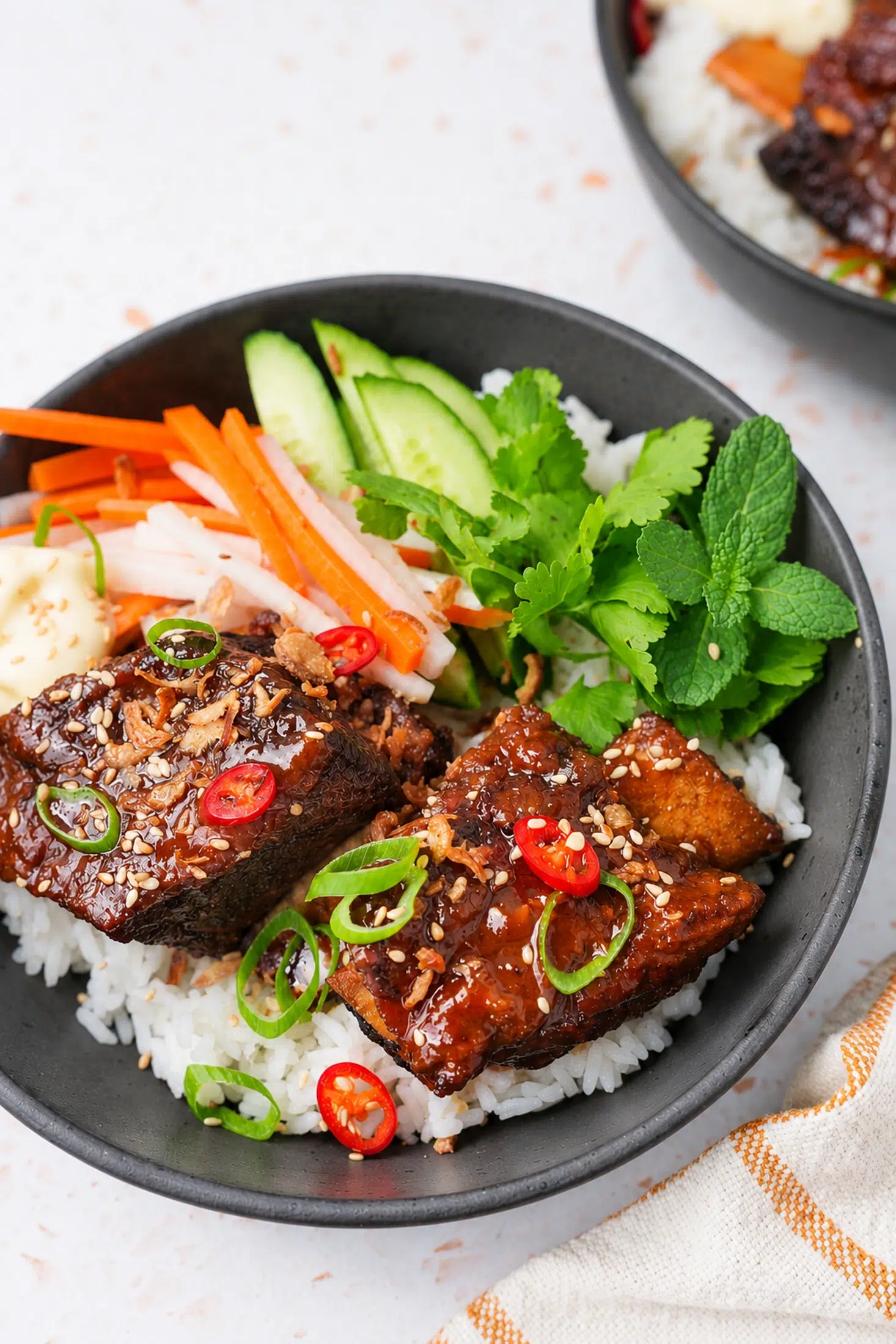
Sticky Miso Beef Short Ribs
Servings: 6 servings
Calories: 896kcal
These Sticky Miso Beef Short Ribs cook low and slow in the oven until fall-apart tender, with a sweet and savoury sauce to spoon over rice. Serve with crunchy carrot and daikon pickle, cucumber, fresh herbs and creamy sesame mayo for a special dinner with very little hands-on cooking.
Ingredients
Beef ribs
- 6 bone-in beef short ribs (see note 1)
- 2 tbsp neutral oil or light olive oil
- 4 garlic cloves, finely grated
- 1 x 4 cm (1½ inch) piece of fresh ginger, finely grated
- 100 g white miso paste
- 55 g firmly packed brown sugar
- 60 ml mirin
- 1 tbsp all-purpose soy sauce
- 750 ml boiling water, plus extra as needed during cooking
- 1 tbsp rice wine vinegar
Quick carrot and daikon pickle
- 125 ml boiling water
- 2 tsp caster (superfine) sugar
- ½ tsp sea salt flakes
- 80 ml rice wine vinegar
- 1 large carrot, peeled and cut into thin matchsticks
- 1 x 8 cm (3¼ inch) piece daikon, peeled and cut into thin matchsticks (see note 2)
Creamy sesame mayo
- 125 g whole-egg mayonnaise
- 2 tsp toasted sesame oil
- 1 tsp rice wine vinegar
- 1½ tsp water, to loosen
Optional cornflour (cornstarch) slurry
- 1 tsp cornflour (cornstarch) mixed with 2 tsp cold water per 250 ml (1 cup) cooking sauce
To serve
- Steamed jasmine rice
- Sliced cucumber
- 5 g loosely packed fresh coriander (cilantro) leaves
- 5 g loosely packed fresh mint leaves
- 2 spring onions (scallions), finely sliced
- Finely sliced fresh red chilli (optional)
- Crispy fried shallots
Instructions
- Preheat the oven – Preheat the oven to 180°C (350°F) (160°C/325°F fan-forced). Pat the beef ribs dry with a paper towel.
- Brown the ribs – Heat the oil in a large heavy-based flameproof casserole dish over medium–high heat. Brown the ribs in batches on all meaty sides, then transfer to a plate. Spoon out some of the excess fat if desired, leaving 2 tablespoons. Turn the heat off.
- Add the braising mixture – Whisk together the garlic, ginger, miso, brown sugar, mirin, soy sauce and water until combined. Pour into the casserole dish and stir, scraping up any browned bits from the bottom. Return the ribs and any resting juices to the dish, arranging them in a snug single layer. Bring to a simmer.
- Slow-cook – Cover tightly with a lid, or baking (parchment) paper and a tight double layer of foil, and transfer to the oven. Cook for approximately 2½–3½ hours, or until very tender, turning the ribs after approximately 1½ hours. Start checking the meat at the 2½-hour mark, as the cooking time will depend on the size and thickness of your ribs. A fork should slide into the thickest part of the meat easily, and the meat should pull apart with very little resistance. If it is still firm, cover tightly and continue cooking, checking every 20–30 minutes. Larger ribs may take longer. Check the liquid when turning the ribs and at each tenderness check. There should still be a pool of sauce around the ribs that flows when stirred. If the sauce has become thick and paste-like, is starting to stick around the edges, or has reduced enough to leave patches of the base dry, gently stir in 60 ml (¼ cup) of water. Add another splash if needed – the sauce should loosen and flow around the ribs again. Cover tightly and continue cooking. (See note 3.) To make in a slow-cooker, see the FAQ section above for all the details.
- Make the quick pickle – While the beef is cooking, combine the boiling water, sugar and salt in a heatproof bowl or jar. Stir until dissolved, then add the rice wine vinegar. Add the carrot and daikon, pressing them into the liquid so they are submerged. Set aside to cool, then cover and refrigerate until ready to serve. Allow at least 30 minutes for the vegetables to pickle, although 1–2 hours will give a more developed flavour. (See note 2.)
- Make the creamy sesame mayo – Combine the mayonnaise, sesame oil and rice wine vinegar in a small bowl. Stir until smooth, then gradually add the water until the mayo is thin enough to drizzle from a spoon. Cover and refrigerate until ready to serve.
- Finish the sauce – Carefully transfer the tender ribs to a plate and loosely cover to keep warm. Skim any excess fat from the surface of the sauce, then stir in the rice wine vinegar. The finished sauce should be glossy and pourable, coating a spoon while still flowing easily. Taste before reducing further. If it is too thick or tastes too concentrated, stir in a little water, 1 tablespoon at a time, until you are happy with the flavour and consistency. If it is too thin and the flavour is balanced, simmer gently on the stovetop until slightly thickened. If it is already rich and well seasoned, use the cornflour slurry below rather than reducing it further.
- Thicken if needed – For a thicker sauce without further reduction, stir the cornflour and water to combine, then gradually stir it into the gently simmering sauce. Simmer for 1–2 minutes, stirring, until thickened. Use the ratio listed in the ingredients as a guide, adding only as much slurry as needed.
- Serve – Return the ribs to the sauce and gently spoon it over to coat. Divide the steamed jasmine rice among serving bowls and top with the beef and sauce. Add the sliced cucumber and a small pile of drained carrot and daikon pickle. Drizzle with the creamy sesame mayo, then scatter over the coriander, mint, spring onion, fresh chilli (if using) and crispy fried shallots. Serve immediately.
Notes
Note 1 – Choosing the beef ribs I recommend buying the short, chunky “English-cut” beef short ribs (also known as Jacob’s Ladder in the UK) rather than the long flanken-style ribs (Argentinian-style/Korean-style). The shorter cut is meatier, easier to fit into the pan, and generally cooks more evenly, which makes it ideal for slow braising. Look for thick, meaty, bone-in beef short ribs, ideally cut into individual pieces with one bone in each. Choose pieces of a similar size so they cook more evenly. Thin, cross-cut or flanken-style ribs, which have several small sections of bone running through each strip, are not suitable for this method.
I prefer smaller, individually cut ribs weighing approximately 300–350 g (10½–12½ oz) each, as they are easier to arrange in the dish and serve. If your butcher has very large pieces, ask them to cut them into smaller portions.
Use approximately 2 kg (4¼ lb) of ribs in total for the quantities listed. If you are cooking significantly fewer ribs, scale down the sauce ingredients and use a smaller dish. Cooking a small quantity in a large dish can cause the sauce to reduce too quickly.
Note 2 – Carrot and daikon pickle Daikon is a mild, large white radish available at Asian grocers and many larger supermarkets. If you cannot find it, use regular red radishes, finely sliced or cut into matchsticks.
Use a small container so the vegetables sit beneath the pickling liquid, and drain only the portion you need for serving. The pickle adds freshness and acidity to balance the beef and sesame mayo.
Note 3 – Your pan and sauce consistency Choose a casserole dish that holds the ribs snugly in a single layer, with room for the sauce around them. A wide dish with lots of exposed surface area will allow the liquid to evaporate more quickly. A tightly fitting lid or tightly sealed foil helps retain moisture.
Even though you do not need to start checking the meat for tenderness until 2½ hours, check the liquid when you turn the ribs. During cooking, the sauce should remain loose enough to flow around the ribs. Add water as directed in the method if it becomes thick or starts drying out.
Miso and soy sauce become more concentrated as the liquid reduces. Once the beef is tender, taste the sauce before simmering it further. If the flavour is already rich and well seasoned, use the optional cornflour (cornstarch) slurry to thicken it.
Make ahead
Beef and sauce – Cook up to 3 days ahead. Cool promptly, transfer the ribs and sauce to shallow airtight containers and refrigerate within 2 hours. Once chilled, the fat will set on the surface of the sauce, making it easy to lift off. To reheat, place the ribs and sauce in an ovenproof dish, adding a splash of water to loosen the sauce. Cover tightly and heat in the oven at 180°C (350°F) (160°C/325°F fan-forced) until piping hot throughout. Allow approximately 30–45 minutes from chilled, depending on the size of the ribs. Check the sauce during reheating and add more water if needed. If using cornflour (cornstarch), you can leave the final thickening until after reheating. Pickle – Prepare up to 3 days ahead and refrigerate in its pickling liquid in an airtight container. Drain just before serving. Sesame mayo – Prepare up to 3 days ahead and refrigerate in an airtight container. Stir before serving, adding a little water if needed to restore a drizzling consistency. To serve – Cook the rice and prepare the cucumber, herbs and toppings on the day. Add the crispy fried shallots just before serving so they stay crisp.Leftovers
Beef and sauce – Refrigerate the beef with its sauce in an airtight container for up to 3 days from cooking, or freeze for up to 2 months. Thaw overnight in the fridge, then reheat, covered, in the oven as above, or gently on the stovetop with a splash of water until piping hot throughout. Reheat only the portion you need. Pickle and sesame mayo – Store separately in airtight containers in the fridge for up to 3 days from preparation. Keep the pickle in its liquid. Neither is suitable for freezing. Rice and fresh toppings – Store separately from the beef and sauce. Cool leftover rice promptly, refrigerate within 1 hour and use within 24 hours, reheating once until steaming hot. Fresh cucumber and herbs are best added just before serving.Recipe source
Thank you to Kim Coverdale for your help developing this recipeNutrition Facts
Sticky Miso Beef Short Ribs
Serving Size
349 g
Amount per Serving
Calories
896
% Daily Value*
Fat
57
g
88
%
Saturated Fat
19
g
119
%
Trans Fat
2
g
Polyunsaturated Fat
10
g
Monounsaturated Fat
25
g
Cholesterol
194
mg
65
%
Sodium
1413
mg
61
%
Potassium
880
mg
25
%
Carbohydrates
23
g
8
%
Fiber
3
g
13
%
Sugar
20
g
22
%
Protein
65
g
130
%
Calcium
69
mg
7
%
Iron
7
mg
39
%
* Percent Daily Values are based on a 2000 calorie diet.
Scan for full recipe:
