
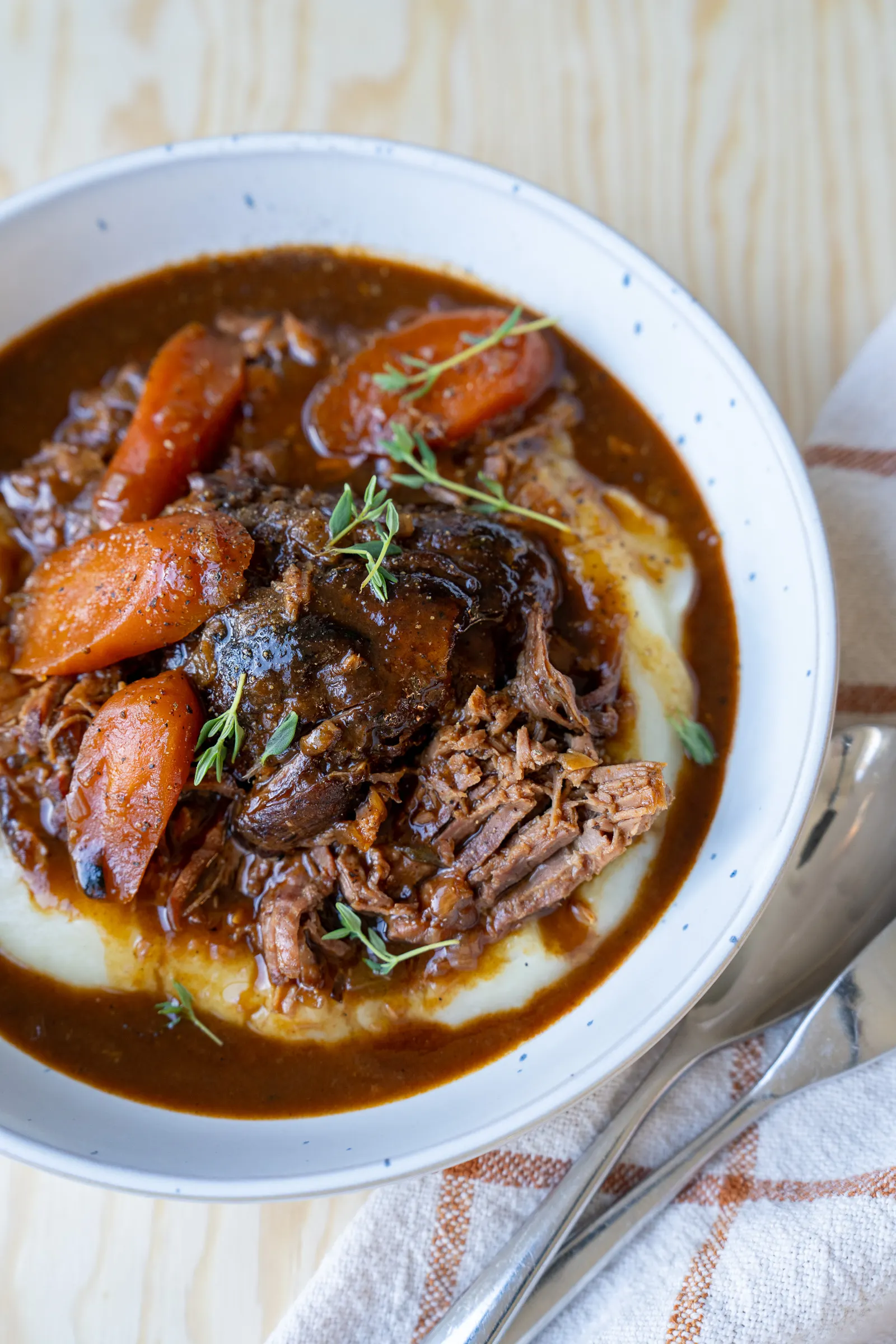
The BEST Beef Pot Roast Recipe
Servings: 6 servings
Calories: 551kcal
This easy oven-braised pot roast is made with a whole beef chuck roast, carrots, celery and onion, slowly cooked until the beef is fall-apart tender. Everything cooks in one pan with a simple homemade beef gravy made from tomato paste, beef stock, Worcestershire sauce and herbs – no packet gravy in sight. Serve The BEST Beef Pot Roast recipe with creamy mashed potatoes for the ultimate comforting family dinner. The hands-on preparation is minimal and the leftovers are just as delicious the next day.
Ingredients
Beef
- 1.2–1.6 kg (2½–3½ lb) beef chuck roast (see note 1)
- 2 tsp sea salt flakes, plus extra to finish
- ½ tsp freshly cracked black pepper, plus extra to finish
- 2 tbsp olive oil
- 2 brown onions, finely diced
- 4 carrots, peeled and cut diagonally into large 5–6 cm (2–2½ inch) pieces
- 3 celery stalks, cut diagonally into large 4–5 cm (1½–2 inch) pieces
- 1 tbsp finely chopped garlic (approximately 6 cloves)
- 2 tbsp tomato paste
- 3 tbsp plain (all-purpose) flour
- 1 litre (4 cups) beef stock
- 1 tbsp Worcestershire sauce
- 4 thyme sprigs
- 2 bay leaves
- 40 g (1½ oz) cold unsalted butter (optional)
- Mashed potatoes, to serve
- Fresh thyme leaves, to serve
Optional, to thicken the gravy
- 1 tbsp cornflour (cornstarch)
- 2 tbsp cold water
Instructions
- Preheat the oven – Preheat the oven to 160°C (325°F) (140°C/275°F fan-forced).
- Brown the beef – Pat the beef dry with a paper towel and season all over with the salt and pepper. Heat the olive oil in a large, heavy-based oven-safe casserole dish (see note 2) over medium–high heat. Add the beef and sear for 4–5 minutes on each broad side, then brown the edges. Transfer to a plate.
- Cook the vegetables – Reduce the heat to medium. Add the onion and cook for 4–5 minutes, stirring occasionally, until softened. Add the carrot and celery and cook for a further 2–3 minutes, stirring occasionally.
- Add the garlic – Add the garlic and cook, stirring, for 30 seconds.
- Build the gravy base – Add the tomato paste and cook for 1 minute.
- Add the flour and stock – Sprinkle over the flour and stir for 1 minute. Pour in the beef stock, then add the Worcestershire sauce, thyme and bay leaves. Stir well and bring to a gentle simmer.
- Braise the beef – Return the beef and any resting juices to the dish, nestling it among the vegetables. Cover with a tight-fitting lid (or cover very tightly with a double layer of foil – see note 3) and transfer to the oven. Cook for 2 hours.
- Turn the beef – Remove the dish from the oven and carefully turn the beef over. Check that there is still plenty of braising liquid in the dish (see note 4). Cover and return to the oven for another 2 hours.
- Check for tenderness – At the 4-hour mark, insert a fork or small knife into the thickest part of the beef. There should be very little resistance and the beef should pull apart easily. If it still feels firm, cover and continue cooking for 30 minutes, then check again. Continue cooking in 30-minute intervals until beautifully tender. For a thick chuck roast, expect approximately 4½ hours total, although the tenderness of the beef is more important than the exact cooking time (see note 5).
- Let it sit – Remove the casserole dish from the oven and leave the beef to sit in the braising liquid with the lid on for 10 minutes. Discard the thyme stalks and bay leaves.
- Finish the gravy – Stir the cold butter through the hot gravy (if using) until melted and glossy. Taste and season with additional salt and pepper if needed. If you'd prefer a thicker gravy (see note 6).
- Serve it pulled or sliced – For a rustic pot roast, leave the beef in the casserole dish and use two large spoons or forks to gently pull it into large pieces. It should come apart very easily. Alternatively, carefully transfer the beef to a chopping board and slice it across the grain. The beef will be extremely tender, so don't expect neat, perfect slices – that's not the goal.
- Serve – Serve the beef with the braised carrots and celery, plenty of creamy mashed potatoes and generous spoonfuls of gravy. Finish with fresh thyme leaves.
Notes
Note 1 – Choose the right beef Chuck roast is ideal because its marbling and connective tissue break down beautifully during slow-cooking. Choose a well-marbled piece wherever possible. In Australia, US and the UK, this cut is called chuck roast, but in the UK it may be called a blade roast or a chuck and blade joint. Brisket can also be used but may require additional cooking time. For a faster version, thick chuck (braising/casserole) steaks can be used instead of a whole roast (see note7).
Note 2 – What is the best pan to use? A heavy casserole dish or enamelled cast-iron pot with a tight-fitting lid is ideal. If you're using a roasting or baking dish instead, cover it very tightly with a double layer of foil, making sure there aren't gaps around the edges where steam can escape.
Note 3 – Keep it tightly covered This is important. You need to trap the steam and moisture inside the dish so the beef can braise gently without the liquid evaporating. Use a casserole dish with a tight-fitting lid or seal a roasting dish very tightly with a double layer of foil. Make sure there aren't any gaps around the edges where steam can escape.
Note 4 – Check the liquid when you turn the beef There should still be plenty of braising liquid in the dish at the 2-hour mark. If your dish has been tightly covered, you shouldn't need to add anything. If there has been unusual evaporation, add a small splash of water or beef stock before covering again.
Note 5 – Thickness determines cooking time Chuck roasts can vary considerably in shape and thickness, even when they weigh the same amount. My roast was approximately 12 cm (4¾ inches) thick and took around 4½ hours. Begin checking at 4 hours and continue cooking in 30-minute intervals until a fork slides easily into the thickest part. If it's still firm, it needs more time.
Note 6 – For a thicker gravy I find the gravy is perfect as it is – the flour and long cooking time naturally create a rich gravy, so there is no need to automatically reduce it on the stovetop. However, if yours is thinner than you'd like, remove the beef and vegetables and place the casserole dish over medium heat. Combine 1 tablespoon of cornflour (cornstarch) with 2 tablespoons of cold water. Stir it into the gravy and simmer for up to 5 minutes, or until the gravy reaches your desired consistency.
Note 7 – Chuck steak option For a faster version, use thick chuck (braising/casserole) steaks rather than one whole roast. Because they're thinner, they'll become tender sooner, so begin checking them earlier. The finished presentation will be different – the steaks sit lower in the braising liquid and won't retain quite the same beautiful browned exterior – but the flavour will still be delicious.
Make Ahead
Pot roast is fantastic for making ahead – and arguably gets even better after sitting in that gravy overnight. Prepare the recipe completely, allow it to cool, then refrigerate the beef, vegetables and gravy together in an airtight container for up to 3 days. To reheat, place everything in a covered casserole dish and warm in a 180°C (350°F) (160°C/325°F fan-forced) oven until piping hot, adding a small splash of water if the gravy has thickened considerably in the fridge. Individual portions can also be reheated gently in the microwave. You can also do your chopping ahead of time. Prepare the onion, carrots, celery and garlic up to 24 hours in advance and refrigerate them in separate airtight containers until you're ready to cook.Leftovers
Store leftover pot roast, vegetables and gravy together in an airtight container in the refrigerator for up to 3 days. Keeping the beef in the gravy helps it stay beautifully moist. Reheat gently on the stovetop over low heat, covered, adding a splash of water if needed. Individual portions can also be reheated in the microwave until piping hot. Leftovers can be frozen for up to 3 months. Cool completely, portion the beef with plenty of gravy into freezer-safe containers and freeze. Thaw overnight in the refrigerator before reheating. And although I could give you fifteen elaborate ideas for reinventing the leftovers, we almost always just eat the exact same dinner again the following night because pot roast + mashed potato + gravy somehow tastes even better on day two! If you do want to change things up, shred the leftover beef, veggies and gravy and pile it into crusty rolls with a little horseradish or mustard, serve it over creamy polenta, or fold the shredded beef through pasta for a very easy second dinner.Recipe Source
A Simple Home Edit original recipe.Nutrition Facts
The BEST Beef Pot Roast Recipe
Amount per Serving
Calories
551
% Daily Value*
Fat
33
g
51
%
Saturated Fat
13
g
81
%
Trans Fat
1
g
Polyunsaturated Fat
2
g
Monounsaturated Fat
15
g
Cholesterol
143
mg
48
%
Sodium
1607
mg
70
%
Potassium
1185
mg
34
%
Carbohydrates
16
g
5
%
Fiber
5
g
21
%
Sugar
10
g
11
%
Protein
46
g
92
%
Calcium
84
mg
8
%
Iron
5
mg
28
%
* Percent Daily Values are based on a 2000 calorie diet.
Scan for full recipe:
