
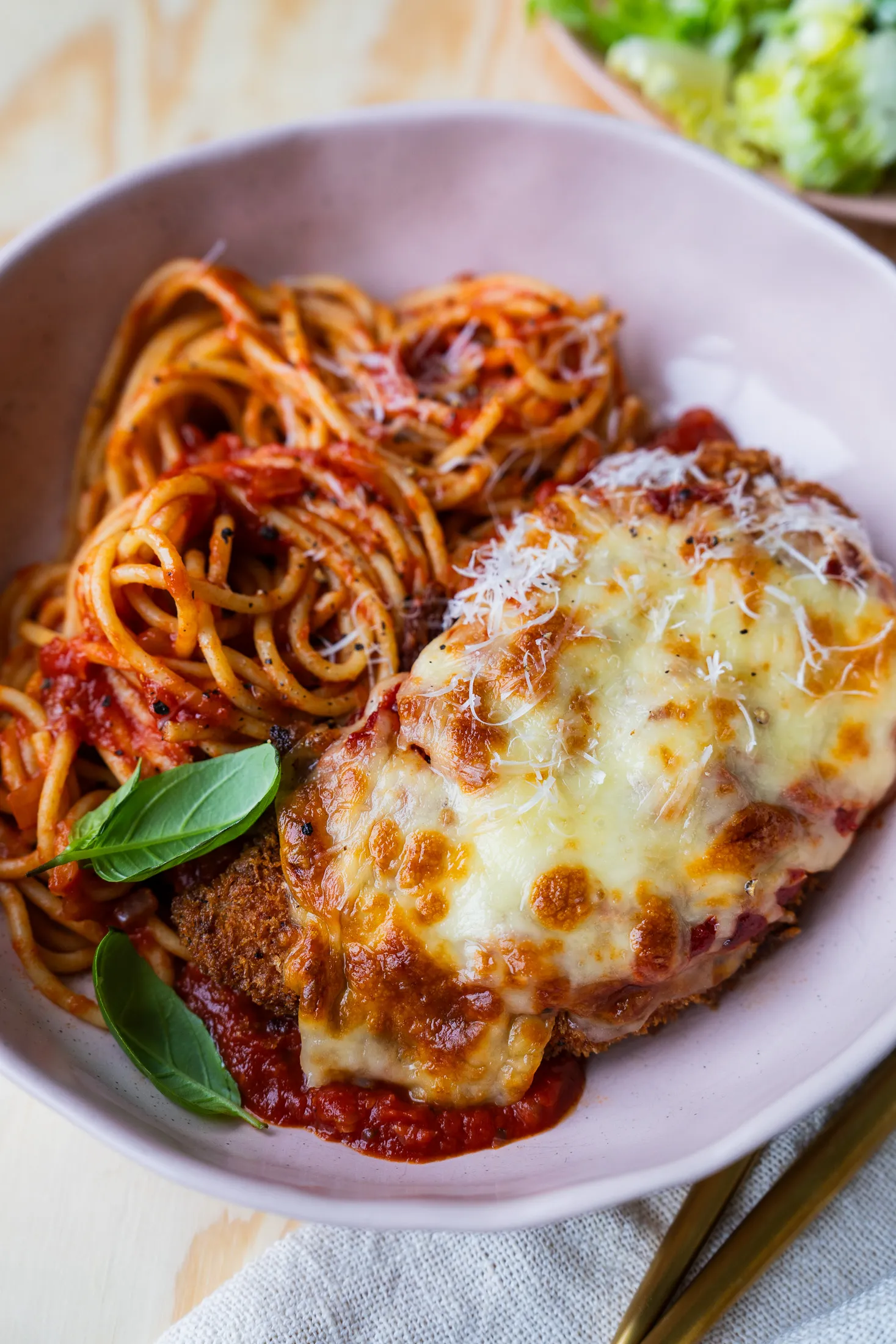
Chicken Parmigiana (Chicken Parmesan)
Servings: 6 servings
Calories: 967kcal
This Chicken Parmigiana (Chicken Parmesan) recipe combines tender, juicy chicken breast coated in golden parmesan and panko breadcrumbs, topped with homemade tomato and basil sauce (marinara) and melted mozzarella. With instructions for both pan-frying and oven-baking, it's a family-favourite dinner that's worth the little extra effort. Serve with spaghetti tossed through the extra sauce, and make a double batch to get ahead for another night.
Ingredients
Tomato and Basil Sauce (Marinara)
- 2 tbsp olive oil
- 1 red onion, finely diced
- ½ tsp sea salt flakes, or to taste
- 1 tbsp freshly grated garlic
- 1 tsp dried oregano
- 1 tsp fennel seeds (optional, see note 3)
- 700 g (1½ lb) passata (strained tomatoes)
- ¼ tsp freshly cracked black pepper
- 1 tsp caster (superfine) sugar (optional, see note 4)
- Small handful of fresh basil leaves, torn
Crumbing (Breading)
- 75 g (½ cup) plain (all-purpose) flour
- 2 eggs, whisked
- 120 g (2 cups) panko breadcrumbs
- 75 g (¾ cup) finely grated parmesan
- 1 tsp garlic powder
To Finish
- 250 g (9 oz) mozzarella, freshly grated or sliced (see note 5)
- Finely grated parmesan
- Fresh basil leaves
Serving Suggestion
- Cheat's Caesar Salad
- See note 6 for gluten-free, dairy-free and egg-free substitutions
Instructions
- Season the chicken – Place the chicken on a large plate or tray. Sprinkle evenly on both sides with the salt and pepper. Set aside for up to 20 minutes while you prepare the tomato and basil sauce, and the rumbing (breading) station. This gives the salt time to season the chicken, helping it retain moisture during cooking.
- Make the tomato and basil sauce (marinara) – Heat the olive oil in a large, deep, heavy-based frying pan over medium heat. Add the onion and salt and cook, stirring, for 3–4 minutes until softened. Add the garlic, oregano and fennel seeds (if using) and cook, stirring, for 30 seconds until fragrant. Add the passata, black pepper and sugar (if using). Bring to a gentle simmer and cook for 10 minutes, stirring occasionally, until slightly thickened. Turn the heat off and stir through the basil.
- Crumb the chicken – While the sauce is simmering, place the flour on a sheet of baking (parchment) paper. Place the whisked eggs in a large, shallow bowl. Combine the panko breadcrumbs, parmesan and garlic powder on a second sheet of baking paper. Working with one piece of chicken at a time, coat it in the flour, shaking off any excess, then dip it into the egg. Press firmly into the breadcrumb mixture, using the baking paper to help gather and press the crumbs onto the chicken. Set aside on a plate and repeat with the remaining chicken.
- Cook the chicken – For oven-baking instructions, see note 2. To pan-fry, preheat the oven grill (broiler) to high. Heat enough olive oil to reach approximately 5 mm–1 cm (¼–½ inch) deep in a large frying pan over medium–high heat. Cook the chicken in batches for 3–4 minutes on each side, or until golden and cooked through. Adjust the heat as needed to prevent the breadcrumbs from burning. Transfer to a large baking tray in a single layer.
- Cook the spaghetti – Meanwhile, bring a large saucepan of salted water to the boil. Cook the spaghetti according to the packet instructions, minus 1 minute. Reserve 125 ml (½ cup) of the pasta cooking water, then drain. Make sure the spaghetti is cooked and drained before moving to the next step. This is important, as you don't want the crispy chicken sitting underneath the tomato sauce while you wait for the pasta.
- Top and grill (broil) – Reserve ⅔ cup of the tomato and basil sauce for the spaghetti. Spoon the remaining sauce over the chicken, leaving some of the golden crumb exposed around the edges. Top each piece evenly with the mozzarella. Grill for 2–5 minutes, watching closely, until the mozzarella is melted, bubbling and lightly golden.
- Finish the spaghetti – While the cheese melts, return the pan containing the reserved tomato sauce to low heat. Add the drained spaghetti and toss to coat, adding the reserved pasta cooking water 1 tablespoon at a time as needed until the sauce coats the spaghetti.
- Serve – Divide the spaghetti among plates and top with the chicken parmigiana. Finish with finely grated parmesan and fresh basil leaves. Serve with caesar salad on the side, if desired.
Notes
Note 1 – Oven-baked chicken parmigiana Oven-baking is an excellent alternative to pan-frying. The breadcrumbs won't become quite as deeply golden, but you'll still get a lovely crispy coating and tender chicken. Season and crumb the chicken as directed in the main recipe. For extra colour, you can add 1 teaspoon of sweet paprika to the breadcrumb mixture.
Preheat the oven to 220°C (425°F) (200°C/400°F fan-forced). Arrange the crumbed (breaded) chicken in a single layer on a large metal baking tray. Spray or drizzle generously with olive oil and bake for 15–18 minutes, turning at the halfway point, until golden and cooked through. To check, cut into the thickest piece to check–the chicken is white throughout.
Once the spaghetti is cooked and drained, spoon the tomato and basil sauce over the chicken, leaving some of the crispy crumb exposed. Top with mozzarella, then return to the oven or place under the grill (broiler) for a few minutes until the cheese is bubbling and golden.
Note 2 – Pounding the chicken Pounding the chicken to an even thickness helps it cook evenly, so you don't end up with dry edges while waiting for the thicker centre to cook through. Place each chicken schnitzel (cutlet) on a chopping board and cover with baking (parchment) paper to prevent splattering. Using the flat side of a meat mallet or a rolling pin, gently pound to approximately 1 cm (½ inch) thick. It doesn't need to be perfect, just reasonably even.
Note 3 – Fennel seeds Fennel seeds have a distinctive, slightly sweet, anise-like flavour, and they're quite strong, so a little goes a long way! I absolutely love them in this tomato and basil sauce. They add a beautiful Italian-inspired flavour that works so well with the chicken and parmesan.
However, I really think you need to know you enjoy fennel before adding it here. If you're unsure or haven't cooked with fennel seeds before, leave them out or start with just ¼ teaspoon. You can also finely crush them if you'd prefer less texture, although this will release more of their flavour.
Note 4 – Sugar in the tomato sauce The sugar is optional, but I highly recommend it. Because this tomato sauce only simmers for around 10 minutes, a small amount of sugar helps balance the natural acidity of the tomatoes without making the sauce sweet. You may not need it if your passata is naturally sweet, but I find it makes a huge difference.
Note 5 – Mozzarella I'm normally a stickler for freshly grated mozzarella. It doesn't contain the anti-caking ingredients often found in pre-shredded cheese, and it melts beautifully. However, this is one of those recipes where I don't think there's a massive difference, so if pre-shredded mozzarella is what you have, absolutely use it!
Sliced mozzarella works just as well. If you're using fresh mozzarella packed in liquid, drain and pat it dry first to avoid adding too much moisture to the chicken.
Note 6 – Gluten-free, dairy-free and egg-free substitutions
Gluten-free – Replace the plain (all-purpose) flour with gluten-free plain flour and use gluten-free panko breadcrumbs or regular gluten-free breadcrumbs. Serve with gluten-free spaghetti and check that your other packaged ingredients are suitable.
Dairy-free – Replace the parmesan in the breadcrumb mixture with a suitable dairy-free alternative, or omit it. Use dairy-free melting cheese instead of mozzarella and omit the parmesan garnish. Check the breadcrumbs for any added dairy ingredients.
Egg-free – Replace the two eggs with approximately 125 ml (½ cup) of milk (any type) or unsweetened dairy-free milk, whisked with 1 tablespoon of plain (all-purpose) flour. Coat the chicken in flour first, dip into the milk mixture, then press firmly into the breadcrumbs. The coating may be slightly more delicate, so handle carefully during cooking.
These dietary substitutions are suggested alternatives and haven't been separately tested with this recipe.
Make Ahead
Chicken – The chicken can be seasoned and crumbed (breaded) up to 24 hours in advance. Arrange the uncooked, crumbed chicken in a single layer in an airtight container, or separate layers with baking (parchment) paper, and refrigerate until ready to cook. Keep refrigerated rather than leaving it at room temperature. Freezing the uncooked chicken – Arrange the crumbed (breaded) chicken in a single layer on a baking tray lined with baking (parchment) paper and freeze until firm. Transfer to an airtight freezer-safe container or bag, separating layers with baking paper if needed. Freeze for up to 2 months for best quality. Thaw overnight in the fridge before cooking as directed in the recipe. Tomato and basil sauce – Prepare the sauce up to 3 days ahead and refrigerate in an airtight container, or freeze for up to 3 months. Thaw overnight in the fridge if frozen, then reheat gently on the stovetop until hot. On the day – Cook the chicken using your preferred method, prepare the spaghetti and reheat the sauce. Only add the tomato sauce and mozzarella to the chicken once the spaghetti is cooked and drained, then grill (broil) and serve immediately. My tip – If I'm making this recipe, I like to double the chicken and tomato sauce so I can freeze half for another dinner. It takes very little extra effort while everything is already set up, and makes chicken parmigiana much more manageable on a busy night.Leftovers
Refrigerate – Store leftover cooked chicken parmigiana and spaghetti in separate airtight containers in the fridge for up to 3 days. Refrigerate within 2 hours of cooking. If the chicken is already topped with sauce and mozzarella, it can be stored as is, although the breadcrumb coating will soften. Reheat in the oven (recommended) – Preheat the oven to 180°C (350°F) (160°C/325°F fan-forced). Place the chicken on a baking tray and heat for approximately 10–15 minutes, or until heated through to the centre. If the crumb is exposed, it may crisp up slightly, although it won't be quite the same as freshly cooked. Reheat in the air fryer – Place the chicken in the air fryer at 160°C (325°F) for approximately 5–8 minutes, checking regularly to prevent the cheese from burning. Heat until piping hot throughout. Reheat the spaghetti – Add the spaghetti to a frying pan over medium–low heat with a splash of water, stirring until heated through. Alternatively, microwave in a covered, microwave-safe container, stirring halfway through. Reheat until piping hot and only reheat the portion you intend to eat. Freeze – Fully assembled chicken parmigiana can be frozen in an airtight, freezer-safe container for up to 2 months for best quality. Thaw overnight in the fridge before reheating in the oven. The breadcrumb coating will soften, so for the best texture, I recommend freezing the chicken uncooked and crumbed instead (see Make Ahead). I don't recommend freezing the cooked spaghetti, as its texture won't be as good once thawed. Shortcuts – You can use good-quality store-bought tomato pasta sauce (marinara) and pre-crumbed (pre-breaded) chicken.Recipe source
A Simple Home Edit original recipeNutrition Facts
Chicken Parmigiana (Chicken Parmesan)
Serving Size
424 g
Amount per Serving
Calories
967
% Daily Value*
Fat
52
g
80
%
Saturated Fat
18
g
113
%
Trans Fat
1
g
Polyunsaturated Fat
5
g
Monounsaturated Fat
25
g
Cholesterol
161
mg
54
%
Sodium
2101
mg
91
%
Potassium
715
mg
20
%
Carbohydrates
76
g
25
%
Fiber
6
g
25
%
Sugar
9
g
10
%
Protein
48
g
96
%
Calcium
731
mg
73
%
Iron
4
mg
22
%
* Percent Daily Values are based on a 2000 calorie diet.
Scan for full recipe:
