
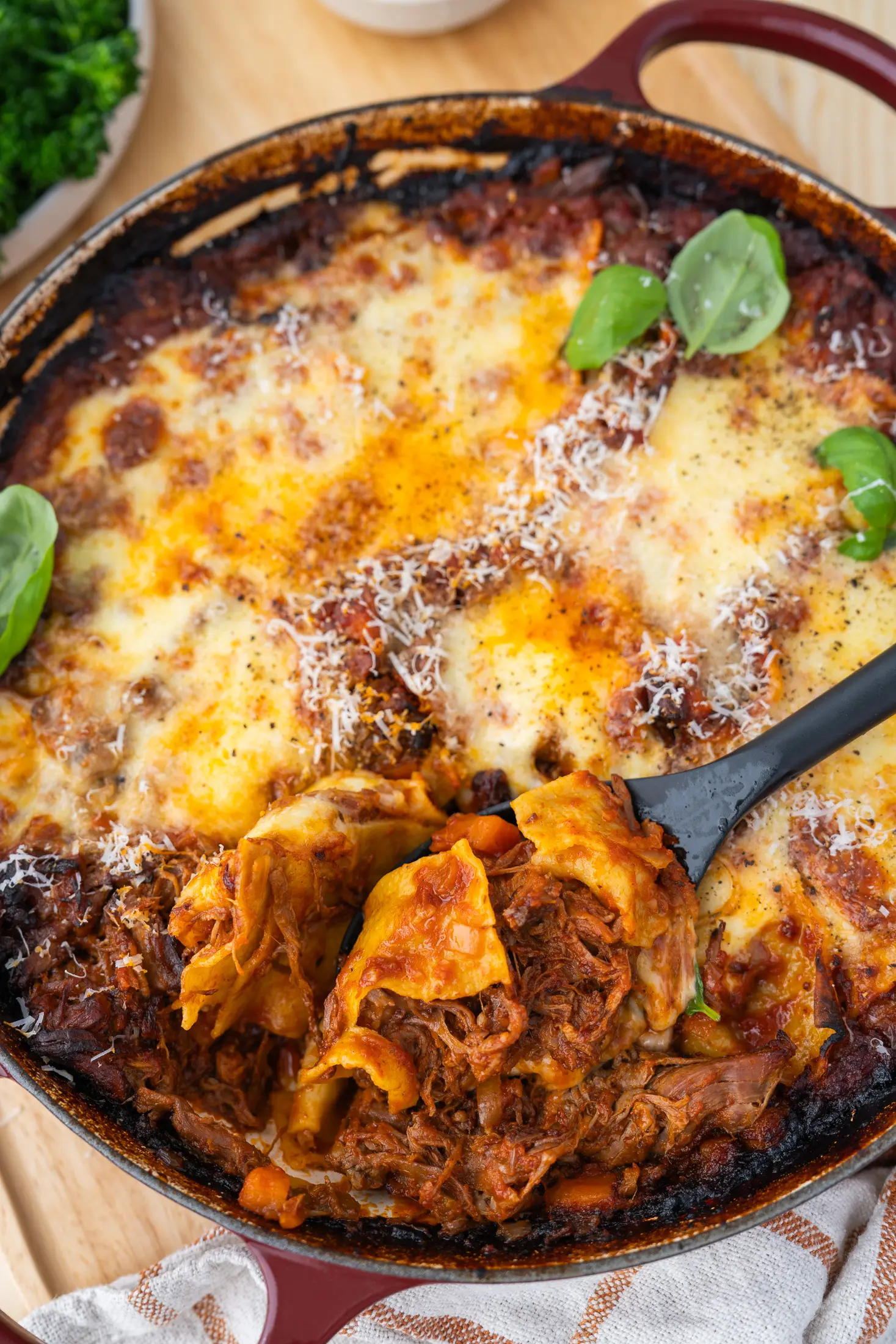
One-pan Beef Ragu Lasagne
Servings: 8 servings
Calories: 530kcal
This One-pan Beef Ragu Lasagne is made by slow-cooking beef chuck roast in a rich tomato, vegetable and herb sauce until fall-apart tender. The beef is shredded straight into the sauce before fresh lasagne sheets are tucked through the ragu and everything is topped with mozzarella and parmesan, then baked until bubbling and golden. There’s no searing the beef, frying the vegetables or layering required, and everything is made in the one casserole dish. Serve it with a simple green salad, steamed greens or garlic bread for a cosy family dinner.
Ingredients
Beef ragu
- 1 large brown onion, finely diced
- 2 carrots, finely diced
- 2 celery stalks, finely diced
- 4 garlic cloves, finely chopped
- 2 tablespoons tomato paste
- 700 g (24 oz) passata
- 375 ml (1½ cups) beef stock
- 1 tsp dried oregano
- 1 tsp dried thyme
- 2 bay leaves
- 1.2 kg (2½ lb) beef chuck roast, cut into 2 large pieces (see note 1)
- 1½ tsp sea salt flakes
- ½ tsp freshly cracked black pepper
- 2 tbsp olive oil
To finish
Instructions
- Preheat the oven – Preheat the oven to 180°C (350°F) (160°C/325°F fan-forced).
- Make the ragu base – Add the onion, carrot, celery, garlic, tomato paste, passata, beef stock, oregano, thyme and bay leaves directly to a large, deep ovenproof casserole dish with a lid. Stir until well combined.
- Add the beef – Season the beef all over with the salt and pepper, then drizzle with the olive oil. Arrange the two pieces of beef on top of the ragu mixture. Don’t push them down into the sauce – ideally, the sauce should come only part-way up the sides of the beef, leaving the tops exposed (see note 1).
- Cover and slow-cook – Place a sheet of baking (parchment) paper over the beef and sauce (optional, see note 4), pressing it gently down so it sits close to the surface, then cover with the lid (also see note 4 if you don’t have a lid). Bake for 1½ hours. Turn the beef pieces over, replace the baking paper (if using), then cover again with the lid and cook for a further 1½ hours.
- Check the beef – Check whether the beef pulls apart easily with two forks. If it is still firm, cover and continue cooking for another 20–30 minutes at a time, checking after each interval, until completely fall-apart tender.
- Shred the beef – Remove and discard the bay leaves. Shred the beef directly in the casserole dish using two forks, discarding any large pieces of fat, then stir the shredded beef through the vegetables and tomato sauce.
- Loosen the ragu – Add 125 ml (½ cup) of the additional beef stock and stir well. Add more, a little at a time, if needed. The ragu should be loose and saucy enough for the lasagne sheets to be easily tucked through it, but not watery.
- Add the lasagne sheets – Increase the oven temperature to 200°C (400°F) (180°C/350°F fan-forced). Tear or cut the fresh lasagne sheets into large pieces, roughly 8–10 cm (3¼–4 inches). Using tongs, tuck the pieces randomly throughout the beef ragu, making sure each piece is well surrounded by sauce. There’s no layering required and it doesn’t need to be perfect.
- Top – Scatter the mozzarella evenly over the top. For an optional bechamel topping, see note 5.
- Bake – Bake, uncovered, for 20–25 minutes, or until the lasagne sheets are tender and the mozzarella is bubbling and golden. For extra colour, turn on the oven grill (broil) on high for 2–3 minutes at the end, if needed.
- Rest and serve – Allow the lasagne to rest for 10 minutes. Finish with the parmesan and fresh basil, then serve.
Notes
Note 1 – Beef chuck roast I use beef chuck roast because it becomes beautifully tender and fall-apart when slow-cooked, while still having enough fat and connective tissue to give the ragu loads of flavour. (In Australia, US and the UK, this cut is called chuck roast, but in the UK it may be called a blade roast or a chuck and blade joint.) Gravy beef (boneless shin), chuck (braising/cassserole) steak or another slow-cooking cut of beef can also be used.
I like using one large chuck roast and cutting it into two large pieces. This speeds up the cooking time while still leaving plenty of exposed surface area above the sauce, which helps the beef brown and caramelise as it cooks. If some or all of the beef ends up submerged, don’t stress – it will still work. I just find you get a little more flavour when part of the beef is exposed.
You can leave the roast whole, but it will take significantly longer to become fall-apart tender – allow around 5–6½ hours, depending on its size and thickness. Check the ragu occasionally and add a little extra beef stock if the sauce is reducing too much.
If using chuck steak or gravy beef already cut into smaller pieces, start checking the beef earlier as it may cook more quickly. Note 2 – Dried lasagne sheets You can use dried lasagne sheets instead of fresh. Break them into large pieces and make sure they are completely surrounded by the ragu so they have enough moisture to soften. When loosening the ragu, use closer to the full 250 ml (1 cup) of additional beef stock, adding a little more if the sauce is particularly thick. Bake for 30–35 minutes, or until the pasta is completely tender and the cheese is bubbling and golden. If the top is browning too quickly before the pasta is cooked, loosely cover with foil for part of the cooking time. Note 3 – Mozzarella I recommend buying mozzarella in a block and either slicing or finely grating it yourself. Pre-grated mozzarella often contains anti-caking agents, which can affect how smoothly and evenly it melts. For larger, molten pockets of cheese, slice the mozzarella and arrange it over the top. This gives you those beautiful stretchy, cheesy sections, although the coverage will be a little less even (this is what I did in the video). For a more even layer of cheese and a beautifully golden finish across the whole dish, finely grate the mozzarella and sprinkle it evenly over the top. Both work beautifully – it just depends on the finish you prefer. Note 4 – Baking (parchment) paper For especially moist, tender beef, you can place a sheet of baking paper directly over the beef and sauce before adding the lid. This helps retain moisture while the beef slow-cooks. It’s completely optional, though – the recipe will still work beautifully without it as long as your casserole dish is covered with a tight-fitting lid. If your casserole dish doesn’t have a lid, cover it very tightly with a double layer of foil instead. Note 5 – Optional bechamel sauce If you love a classic creamy lasagne topping, you can absolutely add a bechamel. Just keep in mind that you’ll need an extra saucepan, so the recipe will no longer technically be one-pan. 😂 Melt 60 g (2 oz) unsalted butter in a medium saucepan over medium heat. Add 50 g (⅓ cup) of plain (all-purpose) flour and cook, stirring, for 1–2 minutes. Gradually whisk in 750 ml (3 cups) of full-cream (whole) milk until smooth. Cook, stirring, for 4–5 minutes, or until thickened enough to coat the back of a spoon. Season with ½ teaspoon of sea salt flakes, ¼ teaspoon of freshly cracked black pepper and a pinch of freshly grated nutmeg, if you like. Once you’ve tucked the lasagne sheets through the ragu, spoon the bechamel over the top and gently spread it to the edges. Scatter over the mozzarella, then bake as directed.
If using chuck steak or gravy beef already cut into smaller pieces, start checking the beef earlier as it may cook more quickly. Note 2 – Dried lasagne sheets You can use dried lasagne sheets instead of fresh. Break them into large pieces and make sure they are completely surrounded by the ragu so they have enough moisture to soften. When loosening the ragu, use closer to the full 250 ml (1 cup) of additional beef stock, adding a little more if the sauce is particularly thick. Bake for 30–35 minutes, or until the pasta is completely tender and the cheese is bubbling and golden. If the top is browning too quickly before the pasta is cooked, loosely cover with foil for part of the cooking time. Note 3 – Mozzarella I recommend buying mozzarella in a block and either slicing or finely grating it yourself. Pre-grated mozzarella often contains anti-caking agents, which can affect how smoothly and evenly it melts. For larger, molten pockets of cheese, slice the mozzarella and arrange it over the top. This gives you those beautiful stretchy, cheesy sections, although the coverage will be a little less even (this is what I did in the video). For a more even layer of cheese and a beautifully golden finish across the whole dish, finely grate the mozzarella and sprinkle it evenly over the top. Both work beautifully – it just depends on the finish you prefer. Note 4 – Baking (parchment) paper For especially moist, tender beef, you can place a sheet of baking paper directly over the beef and sauce before adding the lid. This helps retain moisture while the beef slow-cooks. It’s completely optional, though – the recipe will still work beautifully without it as long as your casserole dish is covered with a tight-fitting lid. If your casserole dish doesn’t have a lid, cover it very tightly with a double layer of foil instead. Note 5 – Optional bechamel sauce If you love a classic creamy lasagne topping, you can absolutely add a bechamel. Just keep in mind that you’ll need an extra saucepan, so the recipe will no longer technically be one-pan. 😂 Melt 60 g (2 oz) unsalted butter in a medium saucepan over medium heat. Add 50 g (⅓ cup) of plain (all-purpose) flour and cook, stirring, for 1–2 minutes. Gradually whisk in 750 ml (3 cups) of full-cream (whole) milk until smooth. Cook, stirring, for 4–5 minutes, or until thickened enough to coat the back of a spoon. Season with ½ teaspoon of sea salt flakes, ¼ teaspoon of freshly cracked black pepper and a pinch of freshly grated nutmeg, if you like. Once you’ve tucked the lasagne sheets through the ragu, spoon the bechamel over the top and gently spread it to the edges. Scatter over the mozzarella, then bake as directed.
Make Ahead
Fridge – Assemble the lasagne completely, up to the point just before baking. Allow it to cool, then cover tightly and refrigerate for up to 24 hours. When ready to cook, bake straight from the fridge at 200°C (400°F) (180°C/350°F fan-forced) for 30–35 minutes, or until the lasagne sheets are tender and the cheese is bubbling and golden. If needed, grill (broil) on high for 2–3 minutes at the end for extra colour. Rest for 10 minutes before serving. Freezer – whole lasagne Bake the lasagne completely, allow it to cool, then cover tightly and freeze for up to 3 months. Thaw overnight in the fridge, then reheat, covered with foil, at 200°C (400°F) (180°C/350°F fan-forced) for 25–35 minutes, or until piping hot in the centre. Remove the foil for the final 5–10 minutes to help the cheese become golden again. Freezer – individual portions Allow the cooked lasagne to cool completely, then portion into airtight freezer-safe containers and freeze for up to 3 months. Thaw overnight in the fridge, then microwave individual portions for 2–4 minutes, or until piping hot throughout. You can add a small splash of water before reheating if the lasagne looks a little dry. If I’m freezing this, I prefer freezing it in individual portions. They thaw and reheat more evenly, and it means I can pull out exactly what I need rather than reheating an entire lasagne.Leftovers
Fridge – Allow the leftover lasagne to cool, then transfer individual portions to airtight containers and refrigerate for up to 3 days. Reheat in the microwave for 2–3 minutes, or until piping hot throughout. If the lasagne looks a little dry, add a small splash of water before reheating. Freezer – Allow the lasagne to cool completely, then transfer individual portions to airtight freezer-safe containers and freeze for up to 3 months. Thaw overnight in the fridge, then reheat in the microwave for 2–4 minutes, or until piping hot throughout. You can also reheat thawed portions in the oven, covered with foil, at 200°C (400°F) (180°C/350°F fan-forced) for 15–20 minutes, or until heated through.Recipe source
A Simple Home Edit original recipe, inspired by Adam Hoad Coaching’s Beef Ragu.Nutrition Facts
One-pan Beef Ragu Lasagne
Amount per Serving
Calories
530
% Daily Value*
Fat
31
g
48
%
Saturated Fat
13
g
81
%
Trans Fat
1
g
Polyunsaturated Fat
2
g
Monounsaturated Fat
13
g
Cholesterol
128
mg
43
%
Sodium
1319
mg
57
%
Potassium
998
mg
29
%
Carbohydrates
16
g
5
%
Fiber
5
g
21
%
Sugar
9
g
10
%
Protein
45
g
90
%
Calcium
302
mg
30
%
Iron
5
mg
28
%
* Percent Daily Values are based on a 2000 calorie diet.
Scan for full recipe:
